
I signed up because you are just getting better and better. – Amir, a paying member
Radical optimism
In the week when oil crossed $100 a barrel and triggered the biggest oil shock in history, we published a radically optimistic analysis of the near future of energy. The world right now may feel like a place where the short run is gorging on the long run – and yet! there are forces that no political decision can eclipse.
We argue that solar power could unlock a cascade of civilizational problems that cheap electricity can solve. Solar energy enjoys learning curves, cheaper with scale, while fossil fuels, for all their remarkable properties, face depletion curves.
At three cents per kilowatt-hour, desalination will no longer be a luxury and water scarcity will stop being “a law of nature”. At one cent, carbon capture will approach economic viability and synthetic aviation fuel will close on fossil jet fuel.
This is the solar supercycle, a self-reinforcing loop where every cost reduction opens a new market and every new market funds the next cost reduction. To show its potential, we built a model grounded in fifty years of Wright’s Law data that maps when each threshold arrives and which markets open up. The model allows you put put in your own assumptions: bearish, bullish or something in between. Paying members have had the model since Thursday. Today it opens to everyone: solar.exponentialview.co 🌞

An agentic nation
Chinese local governments are competing to normalise AI agent adoption. Around 1,000 people lined up outside Tencent’s headquarters to get OpenClaw installed last week. Paid installers appeared on Chinese consumer platforms almost immediately, charging for setup even though the software is free. Six major platforms pushed out hosted or one-click versions within days. Users from China make up nearly 40% of the 200,000 publicly visible OpenClaw agents.

I recommend reading Poe Zhao’s essay on this:
From DeepSeek in 2025 to OpenClaw now, Chinese media have been hammering one narrative non-stop: learn this AI tool, get a high-paying job.
Government agencies are offering multimillion-yuan subsidies to startups using OpenClaw. Alibaba’s DingTalk gave out unlimited API calls through March 31; developers could deploy for as little as $1.4. A whopping 83% of survey respondents in China said AI products and services were more beneficial than harmful. In the United States, only 39% agree.
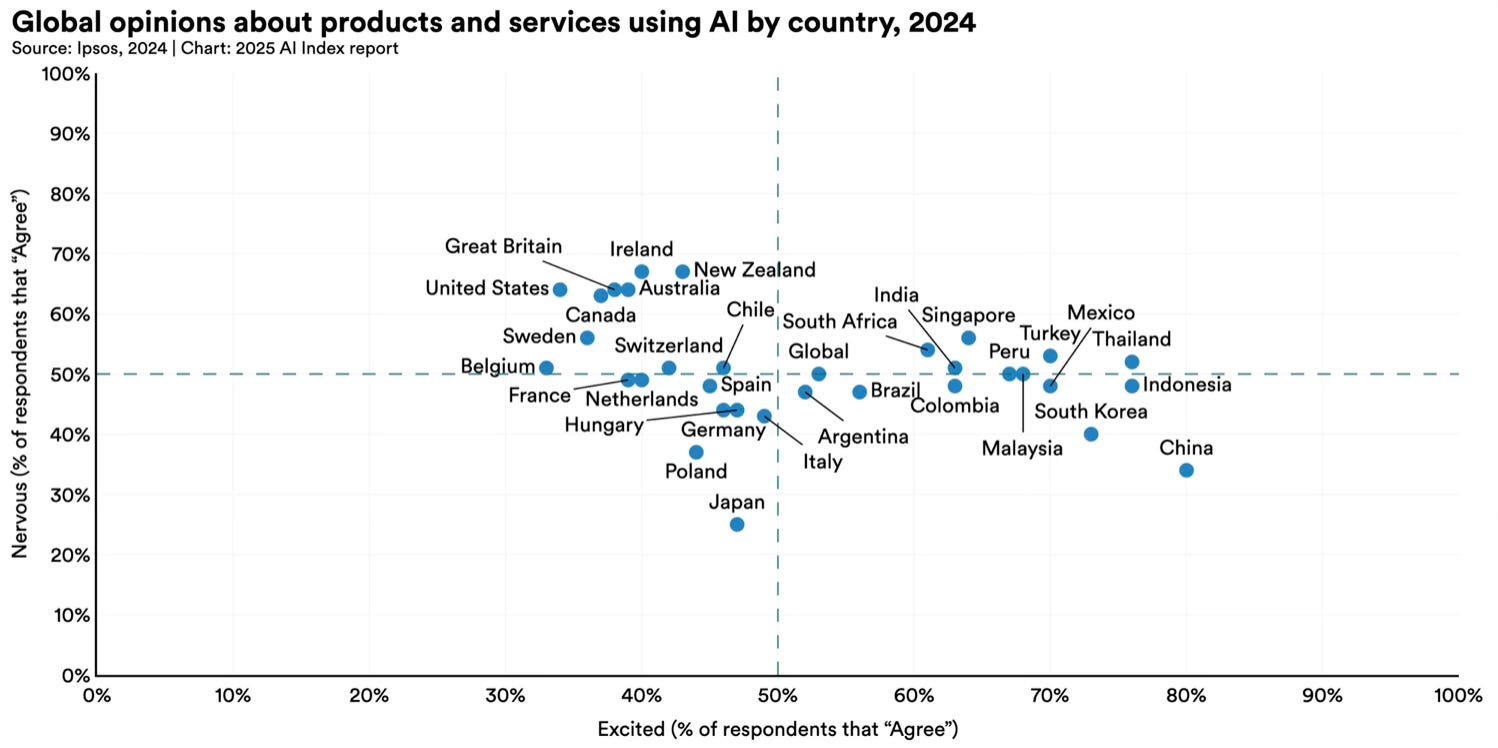
That gap will have a cost. Sequoia partner Alfred Lin estimates that the top 5-10% of builders using AI coding tools are now 3-5x more productive than a year ago because they orchestrate fleets of agents to code for them. Through my own use of OpenClaw, I’ve found it to be self-compounding, meaning the more I use it, the better it gets, the more productive I am.
See also:
Meta has acquired Moltbook, a social network for agents. Moltbook is one of the most important places on the internet.
Autoresearch
One of the most interesting things that happened in AI this week was seeing Andrej Karpathy’s autoresearch run 700 experiments over two days. In that time, it found around twenty improvements that cut the time to train a language model to GPT-2 level of capability from scratch, from 2.02 hours to 1.80 hours (some 11% faster).
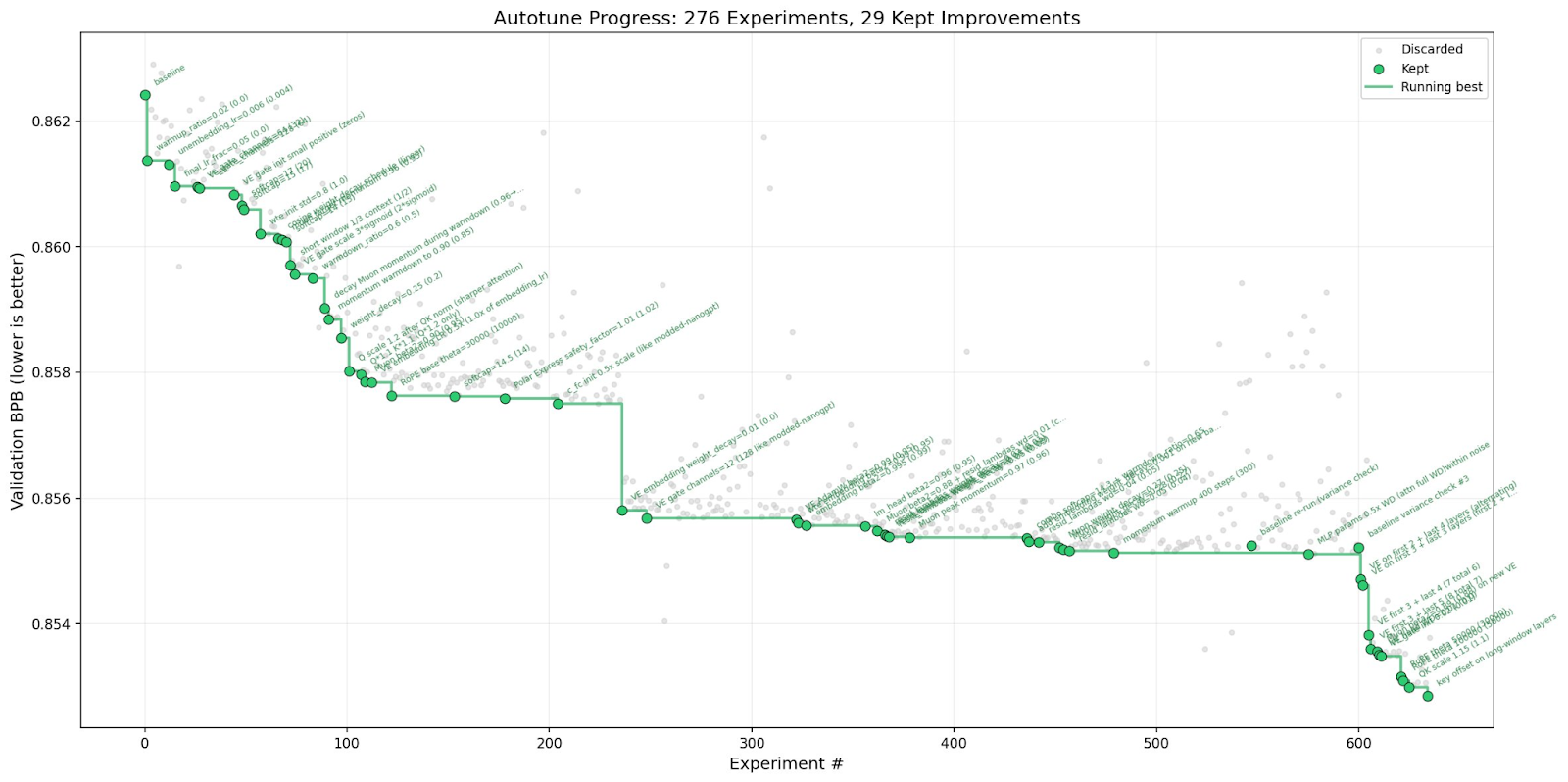
Autoresearch started on a small set of engineering problems, but similarly to tools like Claude Code, it can be applied to any problem you can define, measure and test cheaply:
