
Thomas Piketty, a French economist, has a recipe for global justice.


In the Global Justice Report, Piketty and his co-authors recommend the world converge on a national income of €60,000 (around $68,000) per capita in 2025, in PPP terms, by 2100.
They, too, propose we:
Keep annual growth in Europe and the US to roughly 0-0.5% while poorer countries catch up,
Cut working hours to about 1,000 per worker per year,
Consume fewer material goods and more education, health, care and culture.
Fund the transition with steep taxes, including a wealth tax on billionaires and very high top income-tax rates.
Reports like this arrive with a splash: they profess to be blueprints for a just global economy. But this isn’t that. It’s really a roadmap to Animal Farm.

Nine problems
The report misreads the history. It embraces growth for poor countries while freezing it in rich countries, as if the two were separate. The great escapes from poverty happened through trade, technology, supply chains and frontier knowledge. Much of it originated in wealthier nations. If the economic frontier slows down, the authors need to explain how the channels that allowed poor countries to converge would keep working as before. For a deep dive on growth and extreme poverty, read this.
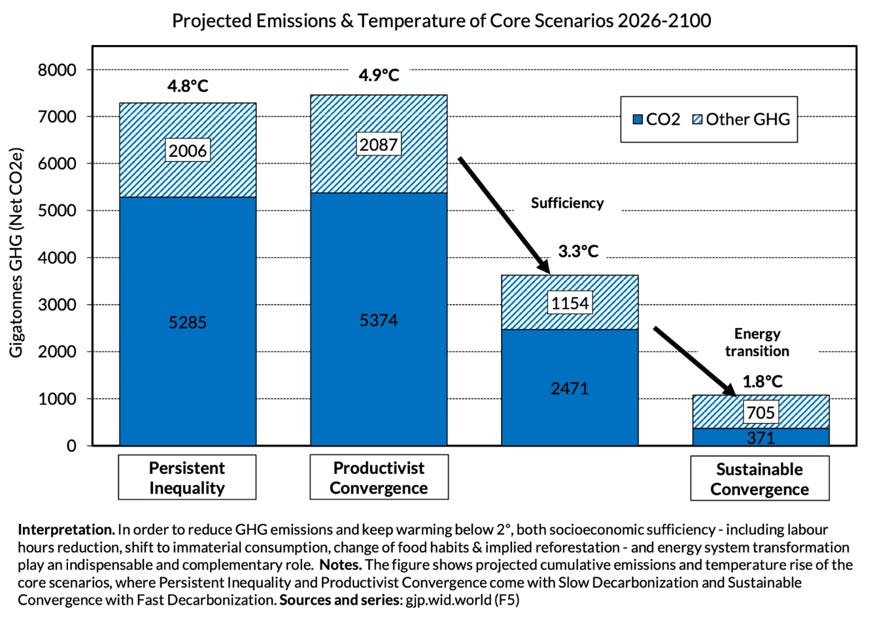
Bad science. For their climate assessment, the policy baseline is set at 4.8-4.9°C by 2100, which roughly aligns with the now discredited and “implausible” RCP 8.5 scenario. RCP 8.5 ignored that learning curves for solar and other renewables exist entirely. Robust academic research dating back to 2016 had already discredited it. (Read Michael Liebreich on this here.)
Piketty has argued he used his own climate modelling projections, which happen to align with RCP 8.5. It makes at least one titanic assumption that we fail to “accelerate the energy transition.” That latter assumption is absurd given this is already happening. Solar, batteries, electric vehicles and many other technologies are on steep learning curves and spreading like topsy.
Implausible politics. In the proposal, global incomes would converge at €5,000 per month (about $5,700) by 2100, with lower inequality within countries. For Western Europe and America, this would essentially mean a freeze on economic growth. In the case of the US, a growth in incomes of 0.12% per annum for 75 years. It is impossible to imagine 18 US electorates, from 2028 to 2096, agreeing to this. There would have to be some kind of external force majeure, an extraordinary top-down imposed policy against the will of citizens in nations across the globe. This is anti-democratic in its own right.