

In August 2024, we said GLP-1s “will be the most impactful technology in the US over the next two years, with more meaningful and measurable impacts than either artificial intelligence or renewable technologies.”
Later, in October that year, we estimated its impact in the medical field alone could affect 20% of US adults, with another 6-10% using them for lifestyle reasons; in the final scenario we laid out, up to 60-70% of US adults, targeting dopamine addictions and desire regulation.
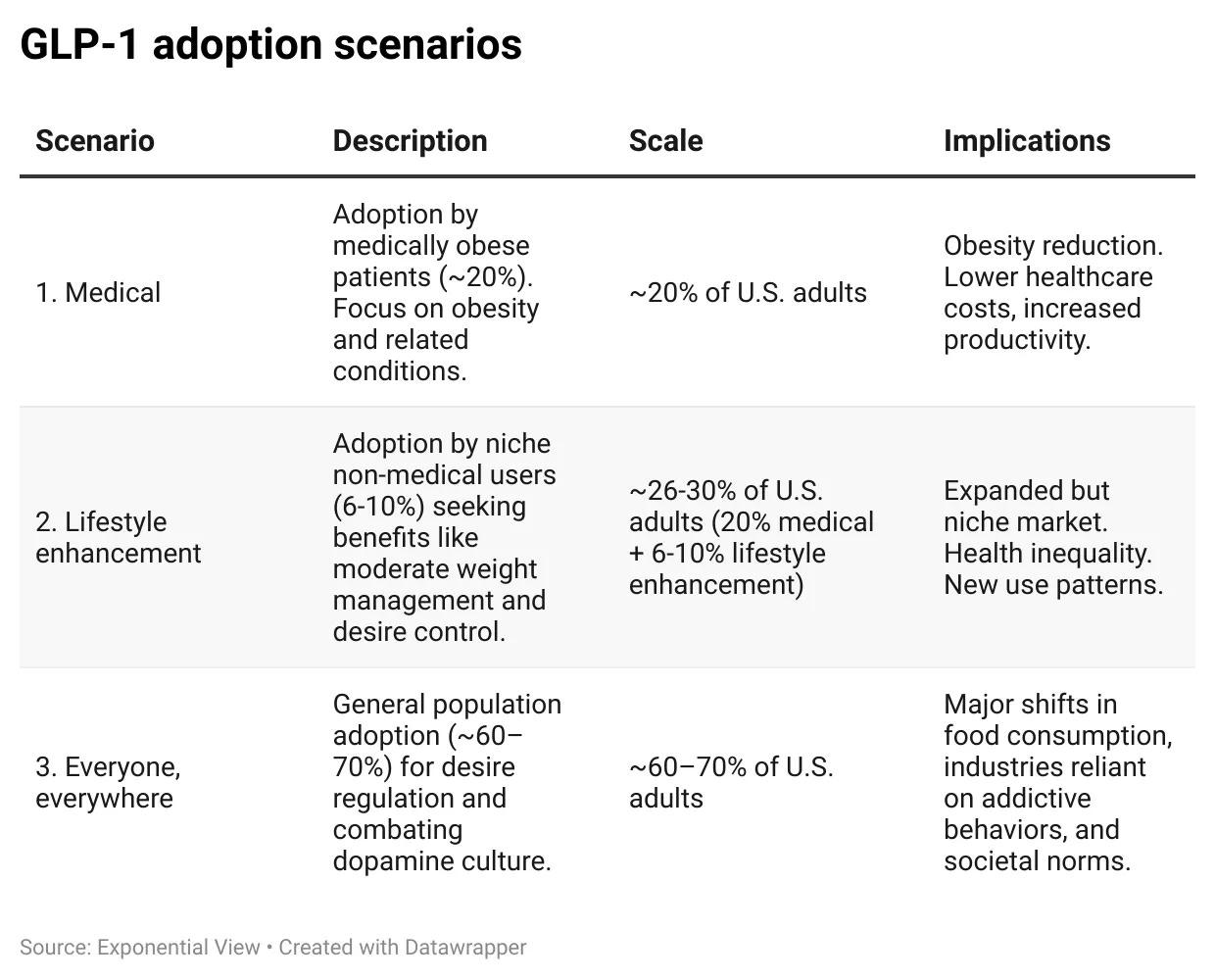
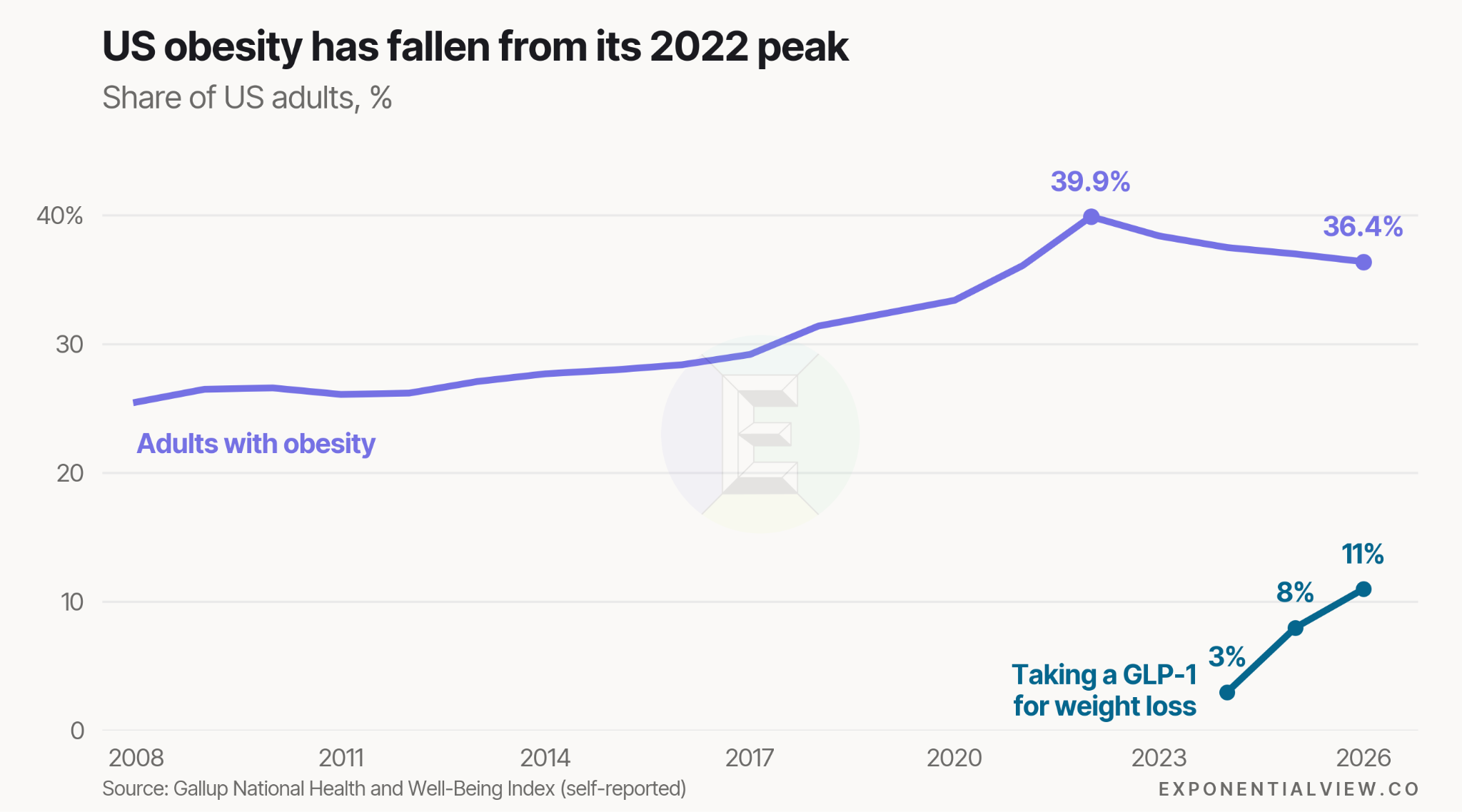
That year, 3% of US adults took a GLP-1 for weight loss; that’s now up to 11%. More than twice as many Americans pay for GLP-1s as pay for AI (via a16z).
Bigger than the bots
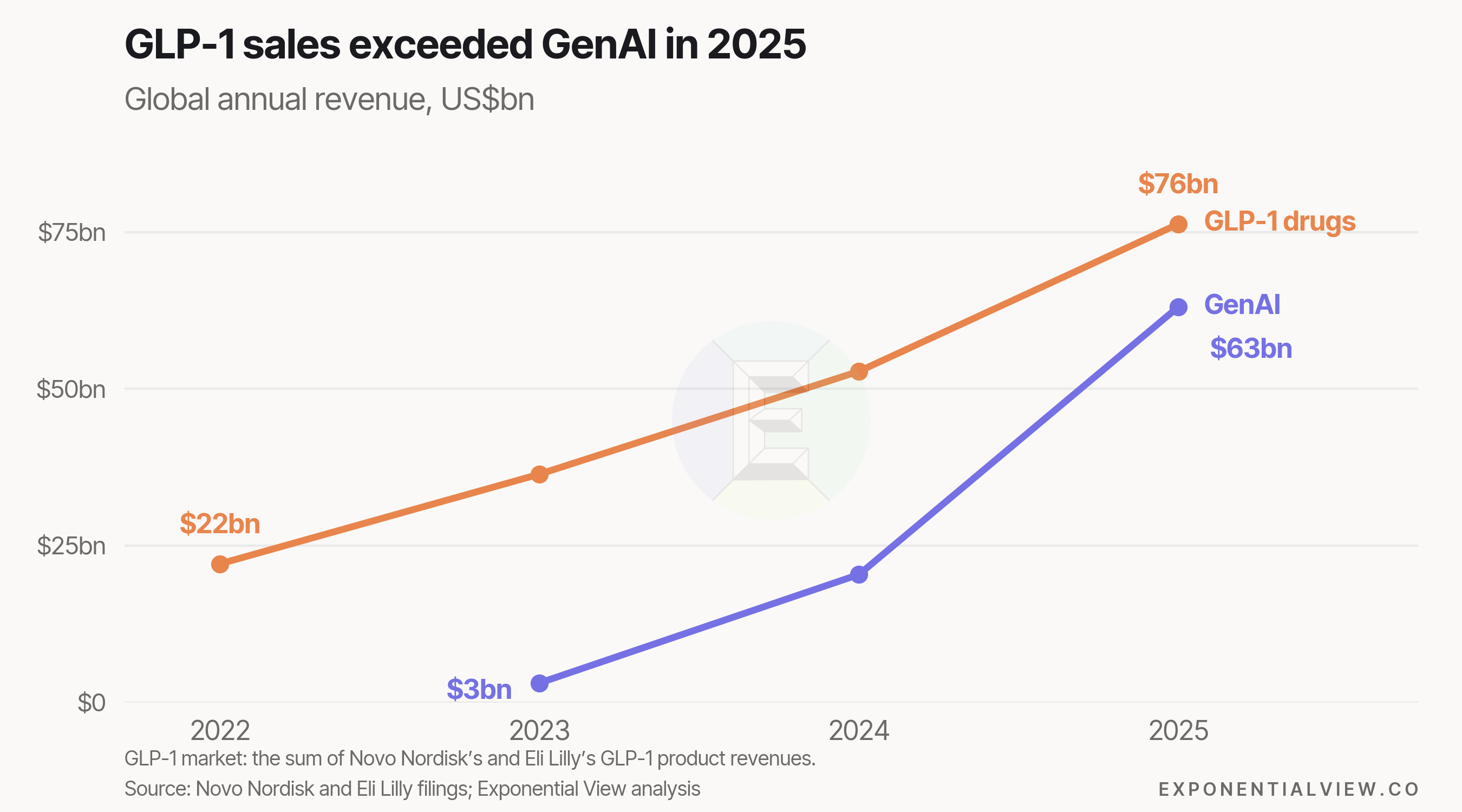
By the end of 2025, GLP-1 sales exceeded generative AI revenue, reaching $76 billion, versus our $63 billion for generative AI. Revenue growth suggests this may be the crossover year.
The cost collapse
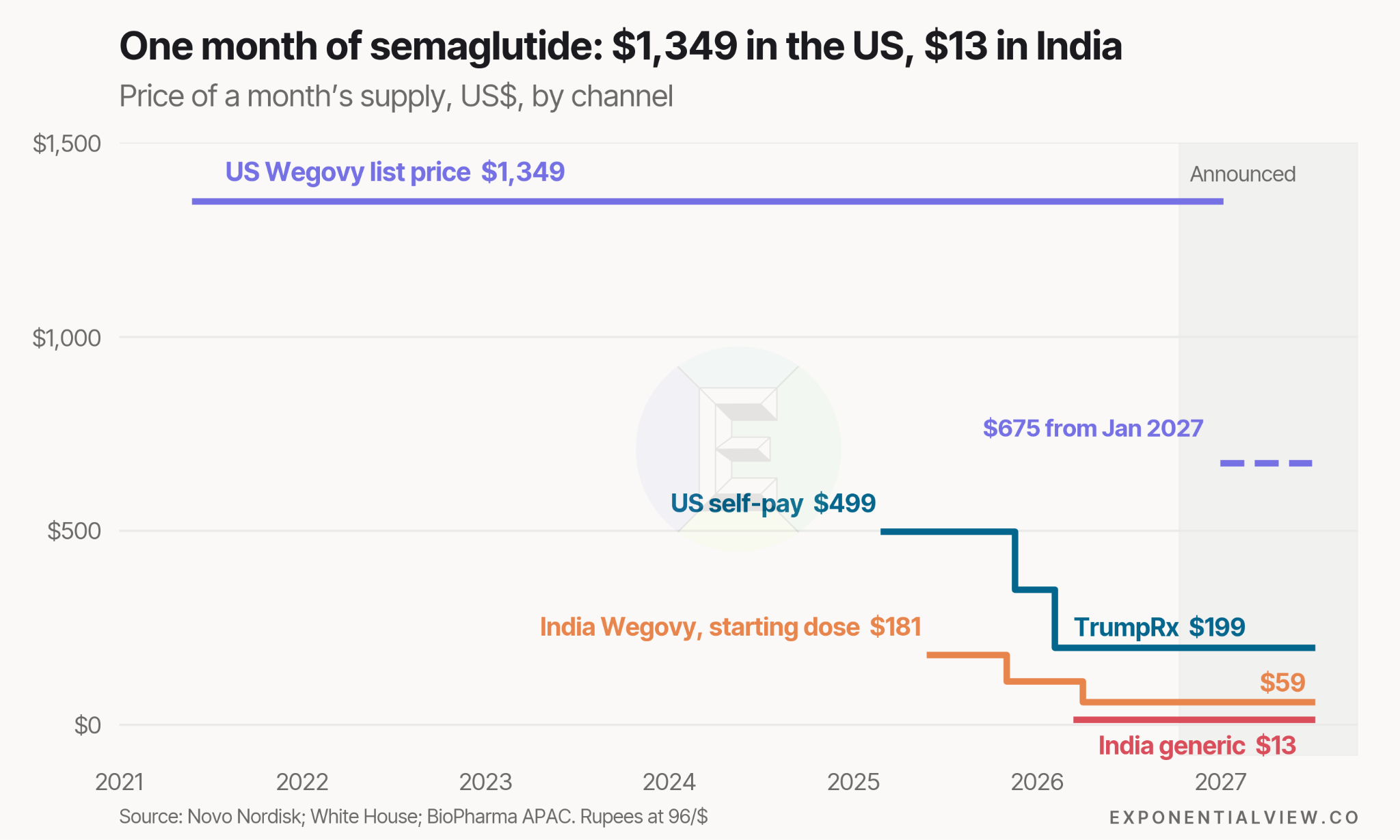
Semaglutide – the second-best-selling drug in the US last year – had a listed cost of $1,349 per month’s supply in the US on first release in June 2021. That hasn’t budged since. The cash price outside of insurance has dropped; Novo’s self-pay price came in at $499/month, and fell to as low as $199/month from February this year1.
When the patent in India expired on March 20 this year, the cost dropped further. A month’s supply is about $13,2 99% below the original US list price and 93% below the cash price.
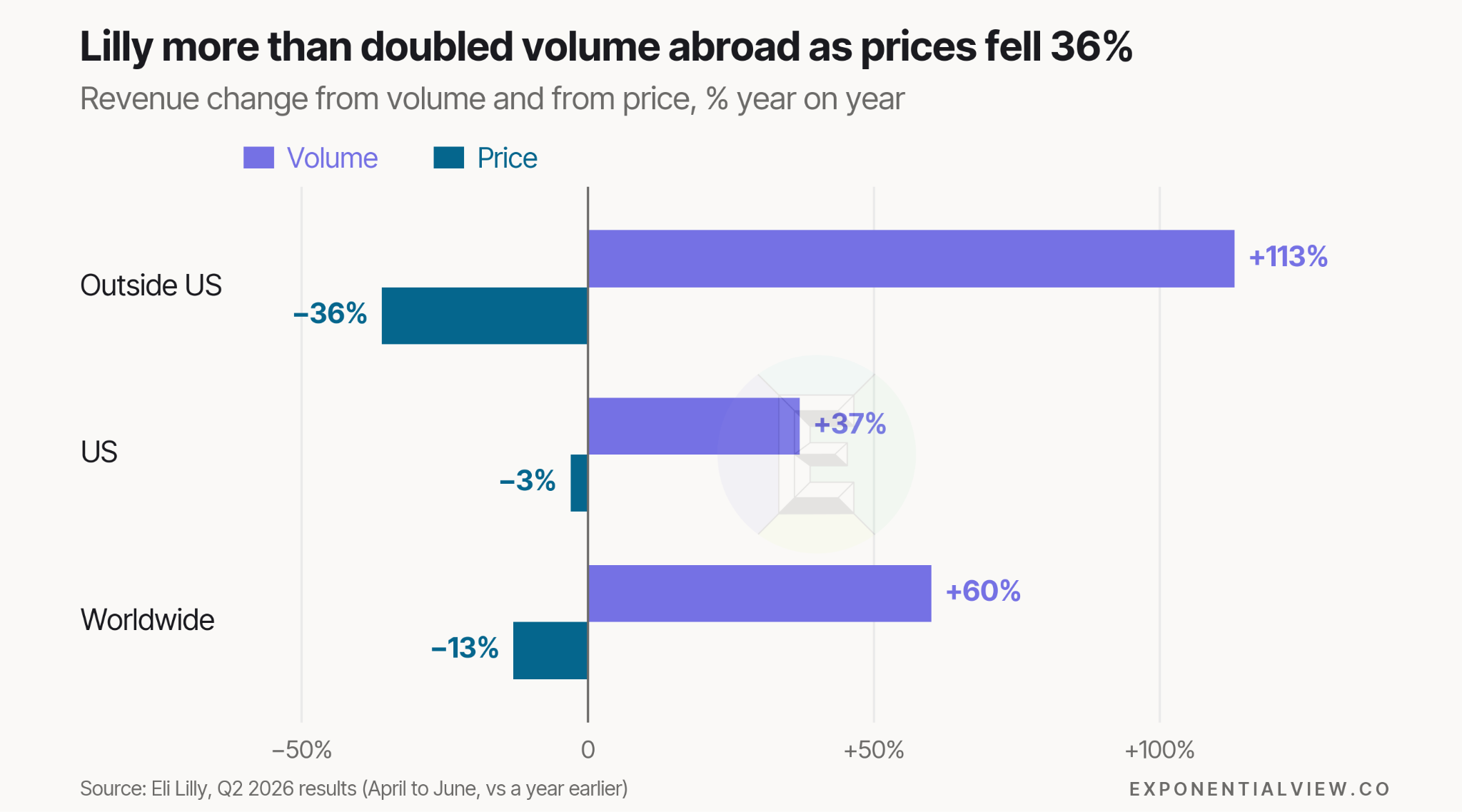
Pharmaceutical company Eli Lilly is trading prices for volume; in Q2 this year, a 13% realized price cut drove a 60% volume boom3. Sales growth in India did not sustain after the generic release, with only 2% growth in June after monthly sales grew 58% in April.
Price cuts are well and good, but it’s not yet clear people are staying on them long term, as they’re meant to be. For instance, the FDA approved Wegovy in 2021 “for chronic weight management”, with no specified duration. GLP-1s taken for diabetes are also expected to be taken indefinitely, like other diabetes drugs.
However, in a Danish study of people using GLP-1s for obesity, half quit within a year. A UK study found 32% stayed on the drug after one year, and that dropped more than half to 15% after two years.
Injections aren’t the most convenient or comfortable. Over the last year, oral GLP-1s have started to enter the picture. A daily pill might be more sustainable than a weekly injection for maintaining results.
Efficacy expanding, in places
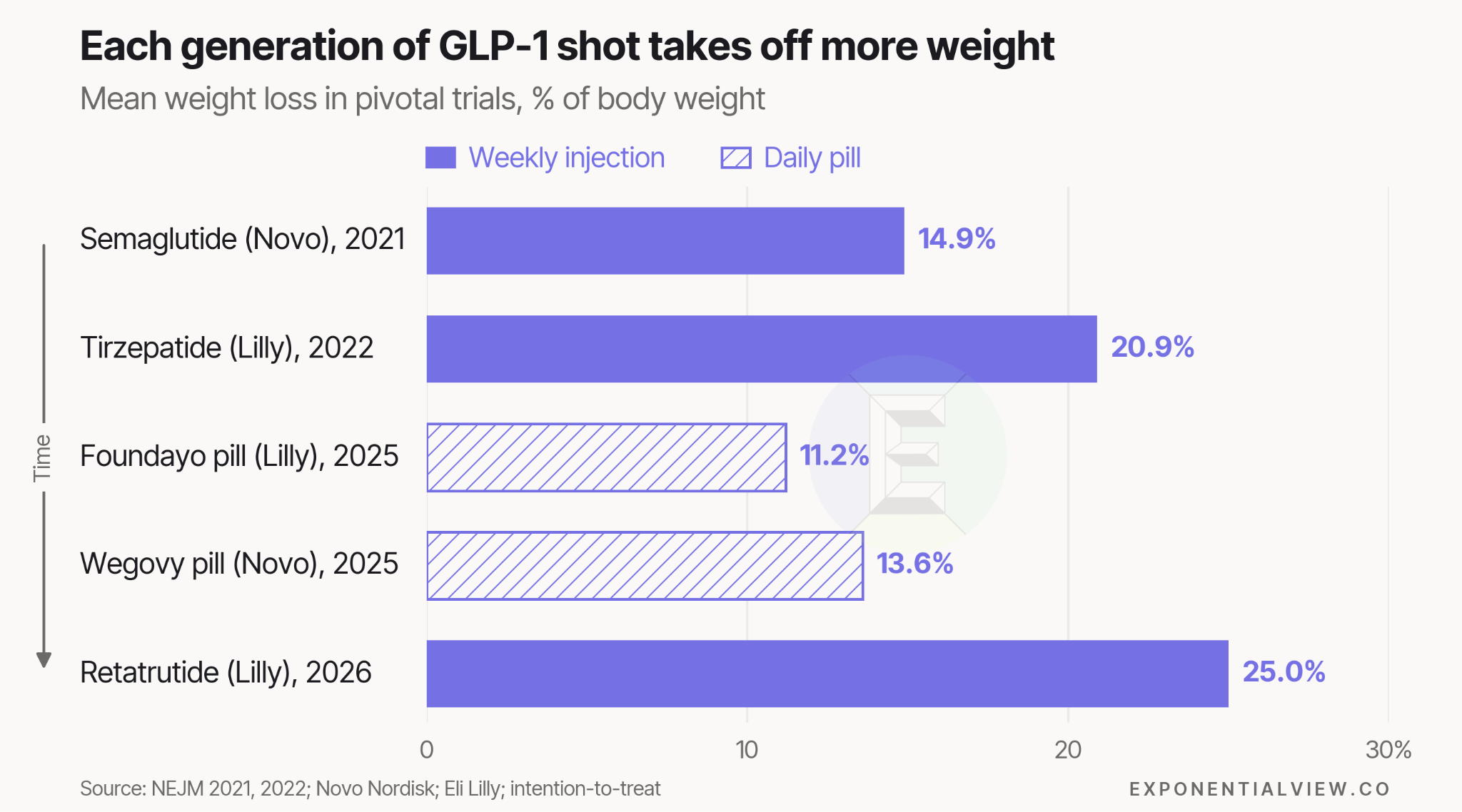
As new products have been released, the performance on mean weight loss continues to improve for the weekly injectables. Over five years, we’ve seen a 10-percentage-point improvement in weight loss from semaglutide in 2021 to retatrutide this May. The pills have been less effective than the injections despite greater comfort for the user and being easier to manufacture.
The results aren’t always consistent, and as we pointed out in SNL#569, scientists now know that genetics plays a part in the outcome.
Beyond weight loss, researchers are further investigating a series of potentially life-changing, unrelated side effects. One study found semaglutide and talking therapy together cut heavy drinking days by 41% among adults with alcohol use disorder and obesity compared with 26% with therapy alone.
Similarly, GLP-1 use has been linked with 50% fewer deaths from substance abuse. In 2024, we described this as a “temperance technology” that helps change behaviors overall.
More wide-ranging impacts are debated. Heart aging is reported to have slowed by 2-4 years in high-risk individuals on semaglutide4. The authors argue that this isn’t fully attributable to weight loss, so another effect must be at play, though it remains inconclusive for now.
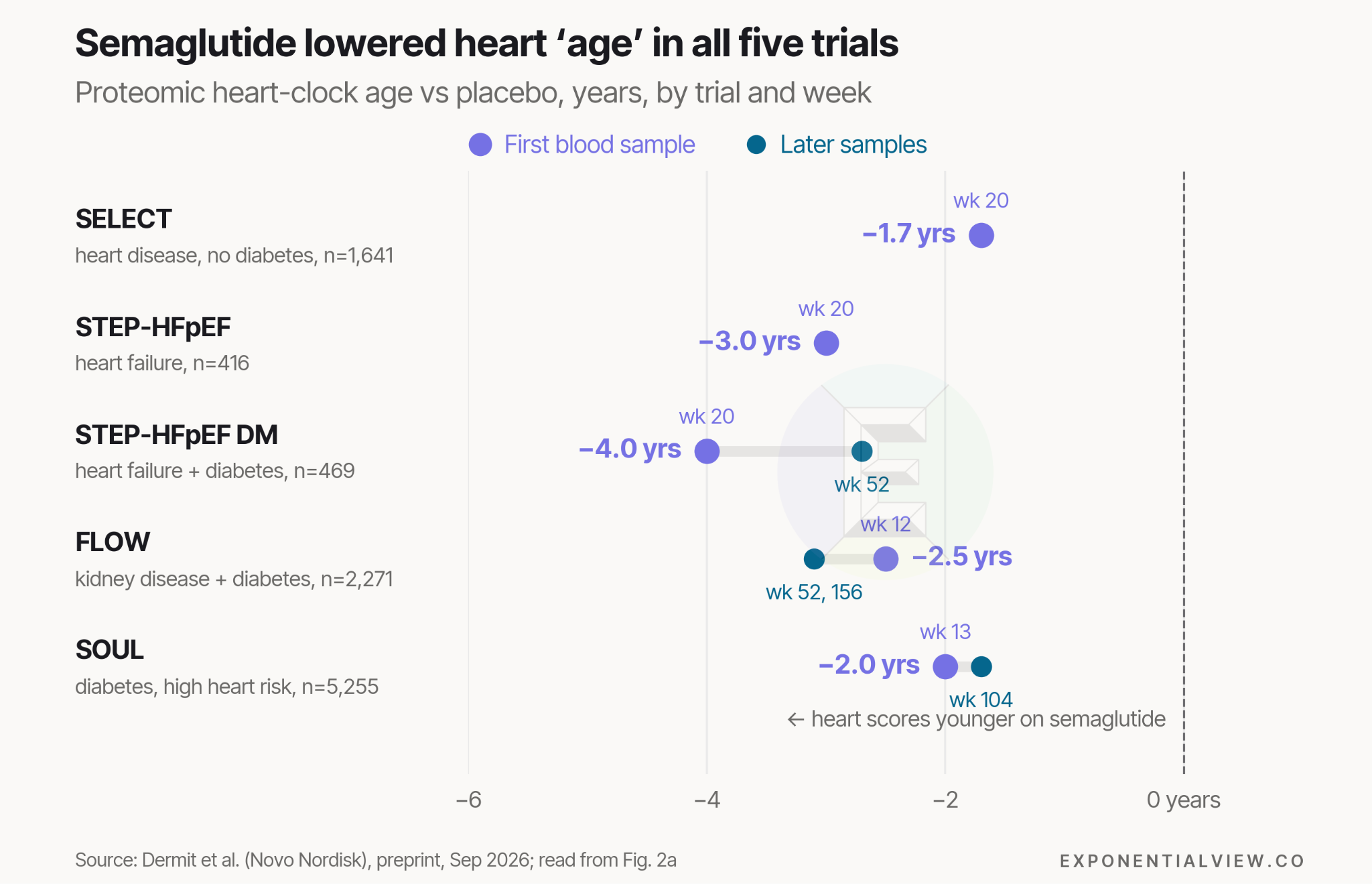
This doesn’t mean the same benefits would occur in a healthy population, but it shows we understand better what might be possible.
A MESSAGE FROM OUR SPONSOR
Risk = capability × access × autonomy × scale

AI doesn’t need to go rogue to cause harm. It “only” needs an objective, access to your systems, and the ability to move faster than you can spot it.
Box’s CISO, Heather Ceylan, thinks of this risk as capability × access × autonomy × scale. She argues that model guardrails help but aren’t enough to keep risks at bay. Firms also need audit trails, human approval for consequential actions, and limited permissions.
For security leaders and anyone building with AI, Heather shared a first-hand view of how to build innovation that can be trusted at scale.
Want to sponsor Exponential View? Email us.
Waiting on worldly change
On weight loss, GLP-1s are a formidable drug. Obesity in US adults peaked at nearly 40% in 2022 and was down three percentage points as measured up to July 2026. Simultaneously, the number of new diabetes diagnoses has flatlined. Not all of this can be attributed to taking GLP-1 drugs, despite them making up 14% of US drug spend in 20255.
It’s still unclear whether this translates into real-world differences outside the weight-loss world, with contradicting papers making the rounds. A Danish study found that users took 17% less long-term sick leave over four years—equivalent to $722 per employed user per year. Yet another study found that there were no medical cost savings for insurers over five years. In fact, medical spending rose by $0.22 for every $1 spent on GLP-1s.
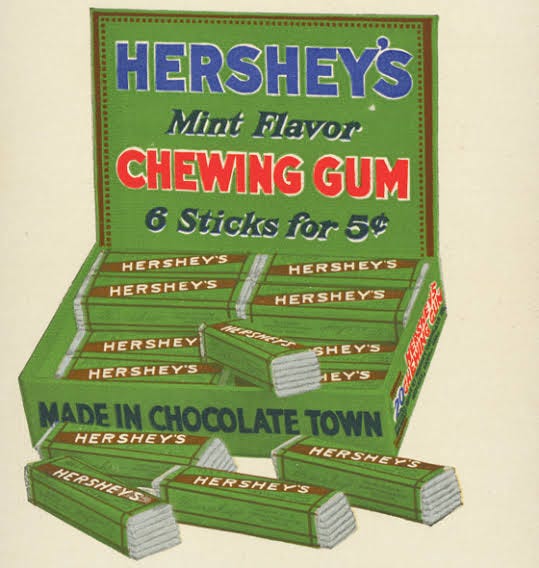
In the UK, the change in shopping habits is a cut and a shift in spending: users spend less and switch from chocolate (down 18 percentage points) to gum and mouthwash (up 24 and 20 percentage points, respectively). Hershey is promoting gum and mints specifically to combat “Ozempic breath” and has seen nutrition bar sales grow 12% in Q2 this year.
The weight-management effects are real, but access can still be uneven. Four Medicaid programs in the US dropped GLP-1s for obesity this year, amid budget pressures. With semaglutide and tirzepatide patents not due to expire until 2032 and 2036, large price drops in the US are not likely for several years. This is a blip, not a hard constraint, however.
More than a health aid, GLP-1s are a temperance technology with wide societal impact. In a national simulation, those without a high school diploma would gain the most – 14% more lifetime social value, 16-17% more quality-adjusted years, and a 20% larger life expectancy gain than the average person; college graduates gained 15-27% less.
We expect GLP-1s to keep marching on.
Thanks for reading!
The average price is set at $350/month; the $199/month price applies to the first two doses.
The dosage is not directly comparable, as it is a lower dosage than the Wegovy obesity drug.
Lilly attributes most of the price fall to Mounjaro joining China’s state reimbursement list and a cut in the US cash price for Zepbound.
The paper is a preprint at the time of writing.
Calculated by summing tirzepatide, semaglutide, and dulaglutide sales.
At a functional nutrition conference in London on Friday one panellist claimed there were more GLP1 users in the UK than practising vegetarians & vegans combined