
I just got back to London after a week at the Annual Meeting at Davos. For the past few years, the World Economic Forum had become a kind of parody of itself, a place where billionaires flew in on private jets to discuss climate change and “stakeholder capitalism” while nothing much seemed to happen. But this year was different.
The AI discussion at the Forum alone was proof of change. It was practical, CEOs asking each other: what’s actually happening with your workforce? Which skills matter now? Why is that company pulling ahead while everyone else flounders?
And on politics, things moved to the heart of the matter: the fragmentation, the end of the old world order. But neither Davos woman nor Davos man felt a deracination in the face of the crumbling rules-based order. Rather, they used the simple fact that many of those who hold the world’s power were gathered in that one place: to speak and, in many cases, to listen.
The gathering met, nay exceeded, its purpose. Davos showed why it matters, why it is necessary in a world that is fraying rather than cohering.
Canada’s prime minister, Mark Carney, gave a speech that will echo for a long time. He spoke of “the end of a pleasant fiction and the beginning of a harsh reality.” He was referring to the unraveling of the post-war geopolitical settlement, the fading authority of the rules-based order, the growing irrelevance of multilateral institutions designed for a slower, more stable world. If you haven’t seen it yet, I really recommend watching.
Carney was talking about treaties, trade, and power. But these aren’t the only norms that are unravelling.
Today’s reflection originates from the research I’m doing for my second book. There’s a long way to go before it lands on your shelf, but that work is already tracing a similar unraveling – in domains much closer to Exponential View’s home. So let’s get to it.
The three crossings
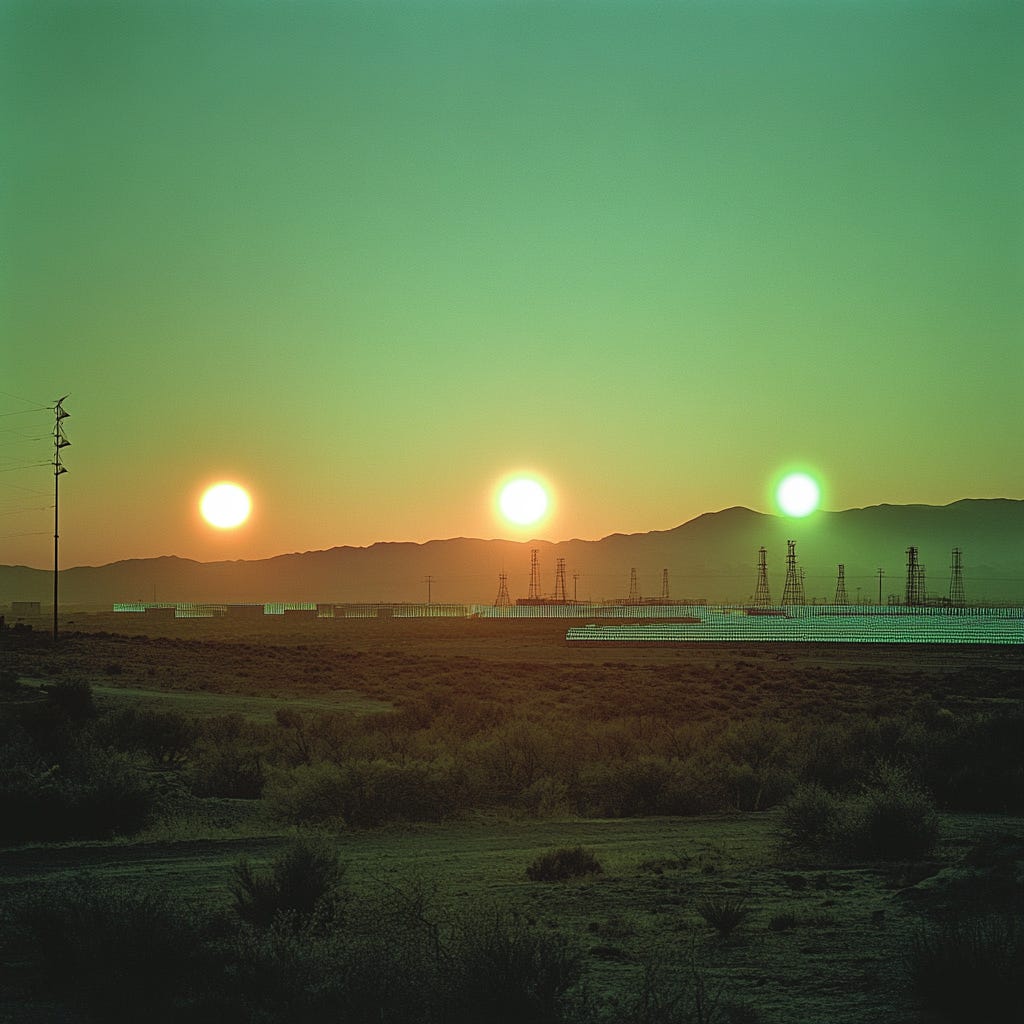
Between 2010 and 2017, three fundamental inputs to human progress – energy, intelligence and biology – crossed a threshold. Each moved from extraction to engineering and learning, from “find it and control it” to “build it and improve it.”
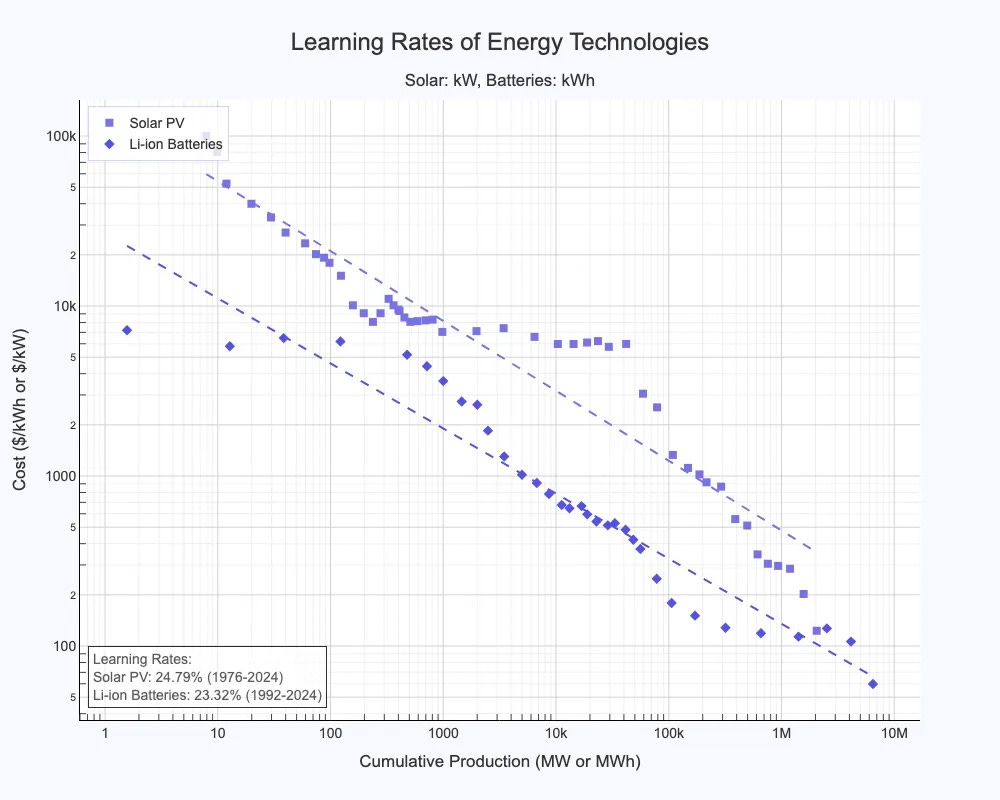
Energy became a technology. For most of human history, energy meant finding something in the ground and burning it. Coal seams, oil fields, natural gas deposits. The logic was geological; as reserves deplete, access is contested, and the nation that controls the supply controls the game. Wars were fought over this. Empires rose and fell on it. Then, solar costs fell below the threshold where photovoltaics could compete with new fossil generation in sunny regions. Wright’s Law in action, as every doubling of cumulative production drops costs by roughly 20%. The learning curve, once it takes hold, is relentless, as Exponential View readers know.
Intelligence became engineerable. For decades, artificial intelligence was a research curiosity plagued by “winters,” periods of hype followed by disappointment. Neural networks worked, sort of, but scaling them was brutal. Progress was uncertain. Capability gains were unpredictable. Then, in 2017, a team at Google published Attention Is All You Need that introduced the transformer architecture. The insight was technical – a new way to process sequences in parallel using self-attention – but the consequence was civilizational. For the first time, there was a reliable scaling law for intelligence: more compute and more data yielded more capability, predictably. AI became a predictable engineering problem. We crossed from uncertainty to a learning curve.
Biology became readable. The human genome was first sequenced in 2003 after roughly $3 billion and thirteen years of work. By the mid-2010s, sequencing costs had fallen to a few thousand dollars, and dropping faster than Moore’s Law.
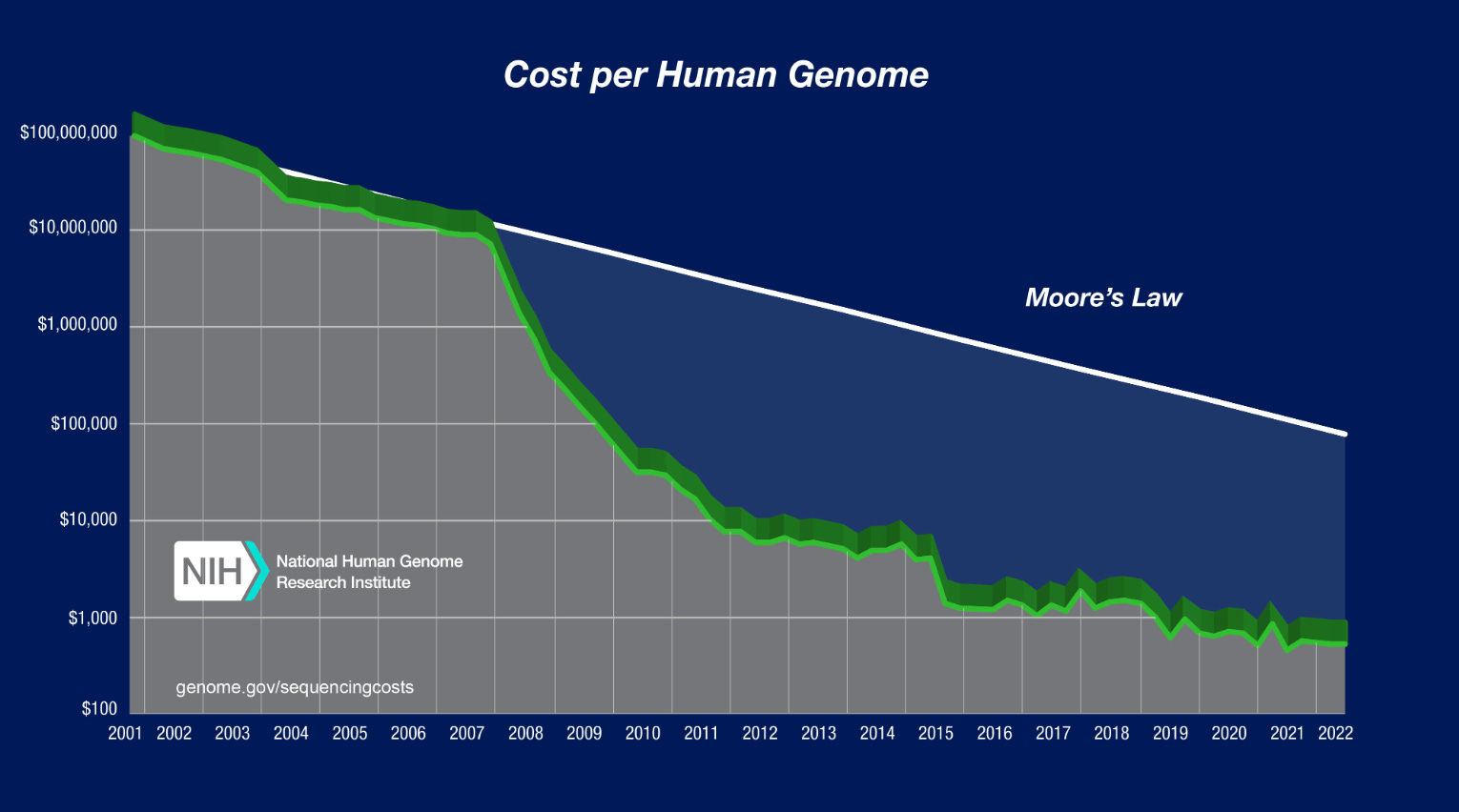
The technologies involved (next-generation sequencing, computational genomics) followed their own improvement curves, and they were steeper than anyone predicted. For the first time in the history of life on Earth, a species could read and begin to edit its own source code. Biology moved from evolutionary timescales to engineering timescales, and as a result we got mRNA vaccines and CRISPR.
Civilizational OS is upgrading
In each of the three crossings, a fundamental input to human flourishing moved from a regime of extraction, where the resource is fixed, contested, and depleting, to a regime of learning curves, where the resource improves with investment and scales with production.
This is not a small shift. It is an upgrade to the operating system of civilization.
For most of history, humanity ran on what I call the Scarcity OS. Resources are limited in this system so the game is about finding them, controlling them, and defending your share. This logic shaped everything – our institutions, our economics, our social structures, our sense of what’s possible.
Under Scarcity OS, certain “fictions” emerged. And I use this word carefully. These fictions weren’t lies; they were social technologies, coordination mechanisms that worked brilliantly in a world of genuine constraint.
Take jobs… Jobs were a fiction. Not in the sense that work wasn’t real, but in the sense that bundling tasks, identity, healthcare, social status, and income into a single institution called “employment” was a specific solution to a specific problem: how do you distribute resources and organize production when information is expensive and coordination is hard? The job was an answer to that question. It was a brilliant answer. But it was an answer to a question that is now changing.
Likewise, credentials were a fiction. When evaluating someone’s capability was expensive, we outsourced the judgment to institutions. A degree from a prestigious university wasn’t proof that you could do anything in particular – it was proof that you had survived a sorting mechanism. The credential was a proxy, a compression algorithm for trust. It worked when the cost of direct evaluation was prohibitive. That cost is collapsing.
Expertise was a fiction. Not the knowledge itself, but the social construct of the “expert” – the person whose authority derived from scarcity of information and difficulty of access. When knowledge was locked in libraries, accumulated through years of study, and distributed through gatekept institutions, expertise was a genuine bottleneck. The expert was a bridge between the uninformed and the truth. That bridge is being bypassed.
These fictions were functional adaptations to real constraints. The job, the credential, the expert, each solved a genuine problem in a high-friction world. But the constraints changed. And now the adaptations are decaying.
Dealing with the decaying of the old
At Davos, I saw three different responses to this decay playing out in real time.
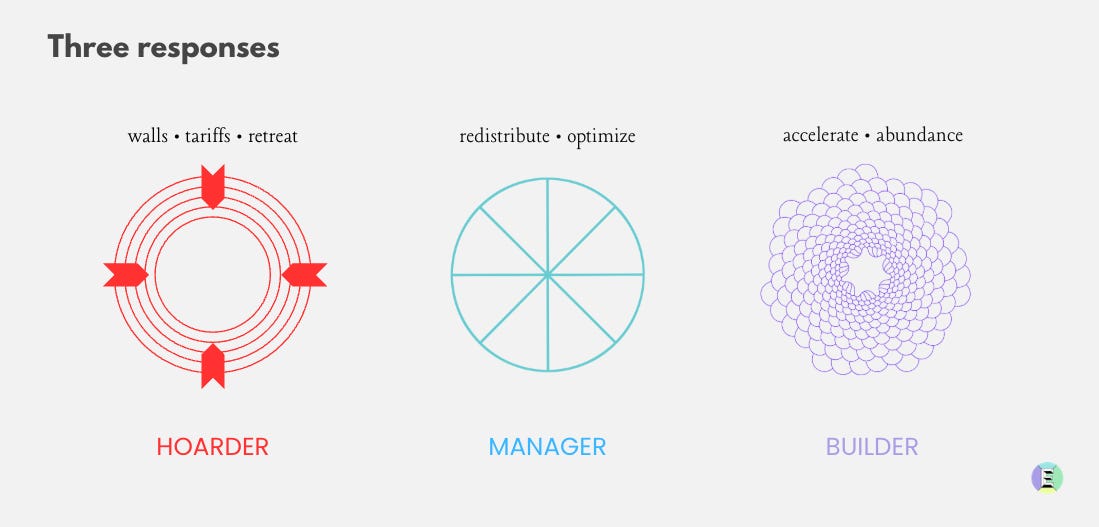
The Hoarder sees the old fictions crumbling and concludes that the game is zero-sum. If the pie is fixed, the only strategy is to take more of it. Build walls. Impose tariffs. Retreat to the nation-state. Punish the outgroup. This is Trump’s instinct, and it resonates precisely because it matches the Scarcity OS that most people still run internally. The hoarder isn’t stupid; he’s applying legacy software to a changed environment.
The Manager sees the same decay and tries to patch the system. Redistribute more fairly. Strengthen institutions. Negotiate better deals within the existing framework. This is Mark Carney’s instinct. It’s more sophisticated than hoarding but it shares an assumption that the pie is still fixed, just poorly divided. The manager wants to optimize the Scarcity OS, not replace it.
The Builder would see something different. If the fundamental inputs are now on learning curves – if energy, biology, and intelligence are becoming cheaper and more abundant – then the pie is not fixed, it’s growing. The game is then about accelerating abundance. The builder’s question will not be “how do I get my share?” but “how do I help make more?”
The tragedy of this moment is that the loudest voices are the hoarders, the most respectable voices are the managers, and the builders are too busy building to fight the political battle.
The terror and the invitation
If you’ve built your identity on the old fictions, this transition is terrifying.