“Always an excellent perspective on emerging systems and their impact across the human landscape.” — Neill K., a paying subscriber
The latest on AI and jobs
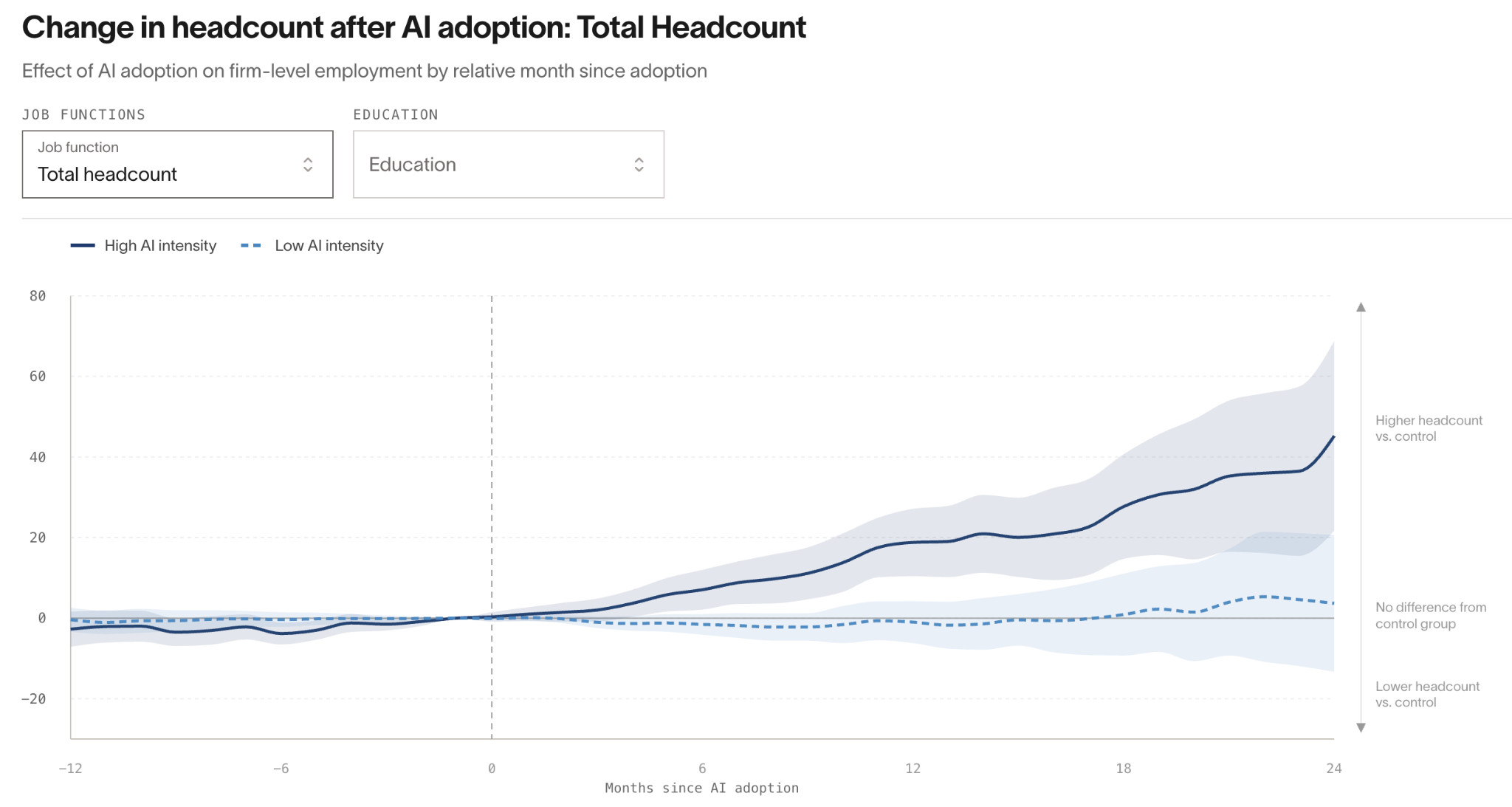
Our friends at Ramp and Revelio Labs released fresh data on AI jobs impact, based on more than 21,000 US firms. They find that heavy adopters grow headcount faster, not slower. These firms increased employment by about 10% over two years after adopting AI. Entry-level roles grew even faster, at 12%.
[H]igh-intensity AI firms are selecting different kinds of candidates. In this case, we believe they are selecting for a new set of skills, specifically, people who know how to use AI and use it well. Entry-level workers, especially recent graduates and college students, are a natural place to look.
We’ve written before that the widely accepted narrative that AI replaces jobs is too simple – this still holds. The opposite claim, that there’s nothing to worry about, is simplistic as well. Labor markets are complex but we can make some assumptions about what’s going on:
First, complementarity. If AI makes workers more productive, firms may want more workers because the return on each additional hire rises.
Second, supervision. As AI-generated work increases, firms may need more people to manage, review and quality-control that output.
Third, demand expansion. If the cost per task falls, more tasks become viable. Latent demand becomes actual demand. (Exactly what has happened with computing since the 1970s.)
Some firms are now learning that they fired people too quickly, mistaking task automation for human obsolescence. As we argued, the initial gains from AI show up in individual productivity, but the harder prize comes when firms redesign entire workflows and decision-making loops around it. There’s no evidence so far that humans aren’t needed in this redesign.
See also:
Medicine is trying to protect against “never skilling,” the risk that trainees rely on AI so much that they never develop clinical judgment.
Goldman Sachs economist Joseph Briggs expects AI adoption to temporarily displace about 9% of the US workforce over a 10-year transition.
Open by necessity
US chip controls have driven China to treat open-source as resilience infrastructure, a new paper argues. Following each major US export control event since 2022, forking of LLM repos on GitHub jumped among China-linked developers but barely moved among US developers – 0.143 additional forks per repository-week for China vs 0.012 for the US, an 11x gap:
When uncertainty around upstream inputs rises, developers appear to increase engagement with open, locally runnable model infrastructure… [This is] a broader shift toward distributed innovation ecosystems that can expand participation, accelerate diffusion, and increase resilience under geopolitical and technological constraints.
Qwen and DeepSeek spread into research and commercial work globally almost as quickly as the best US models. But when authors examined US patents, the use of Chinese-origin models was rarely disclosed.
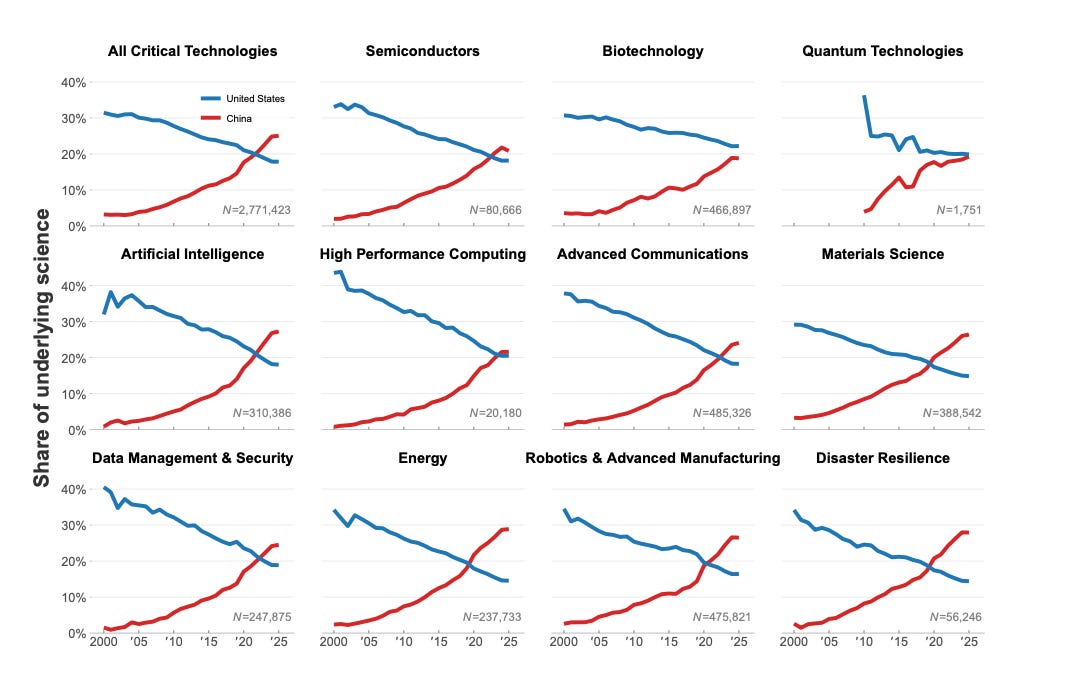
Another new paper suggests that Chinese innovation is becoming more self-reliant. The share of science produced in China that underlies domestic patents has grown from 1% in 2000 to 26% in 2025. China still builds on research done elsewhere, but domestic research is growing.
See also:
Notes from our 10-day visit to major AI labs in China.
One company you likely never heard of controls a large share of the optical transceivers that make every major AI data center work.
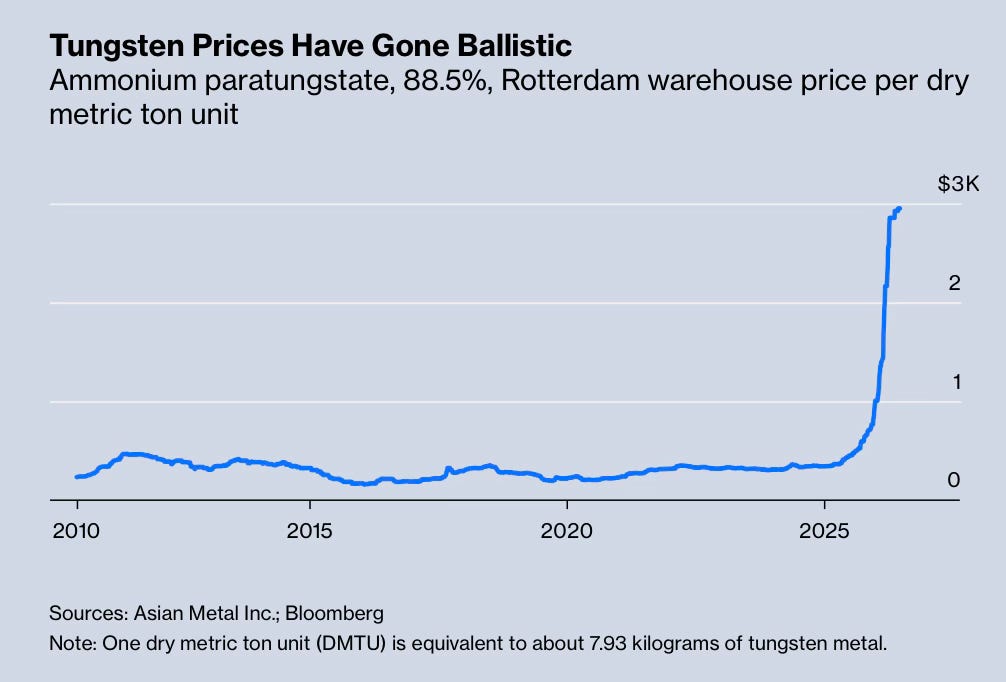
Wars are depleting global tungsten stocks. China mines 80% of it, and the West is scrambling to reopen its mines.