
Hi all,
Happy Sunday. I’m en route to NYC for a week of meetings and speaking. If you’re travelling this week too, it’s a great moment to catch up on my latest podcast episode, where I explain why I changed my mind about Apple’s AI outlook:
Let’s go!
OpenClaw and the inference economy
We’re about to discover, the hard way, that most organizations are thinking about AI in entirely the wrong way.
In a training-first world, it made some sense to see AI as a capital project. But we don’t live in that world any more, as Jensen Huang made clear at NVIDIA GTC this week. We’ve shifted to an inference-first economy, where the dominant activity is running models – continuously, at scale, across millions of workflows and, increasingly, AI agents.
In that world, tokens are not an IT line item. They are a productive input, as fundamental to knowledge work as electricity, office space, or salary. I write about this at some length in my latest essay:
🔮 Jensen’s OpenClaw thesis

Jensen Huang delivered a stunning performance at this year’s GTC. I want to reflect on one thing Jensen said that tells us a lot about the near future of AI:
Pakistan’s solar shield
Energy is the main weapon in the Iran war. As we wrote a couple of weeks ago, this is the old world of energy scarcity on full display. Several import-dependent Asian economies, including Bangladesh, Pakistan and the Philippines, have taken emergency measures to manage the energy shock.
But one country on that list, Pakistan, is faring better than the others. We were one of the first in 2024 to show the silent energy transition Pakistan underwent in the last two years, importing 17GW of solar panels in a single year, against a total generation capacity of 46GW. This transformation, we argued at the time, would be massive for Pakistan’s energy security:
92% of countries would be more energy secure under a renewable paradigm than under a fossil one. Many countries used fossil fuels as a geopolitical weapon. From OPEC’s oil embargoes to Russia’s manipulation of natural gas, control over these resources gave them significant power. With renewables, this power dissipates. Once you have the solar panel, you have the energy – OPEC can’t block the sun.
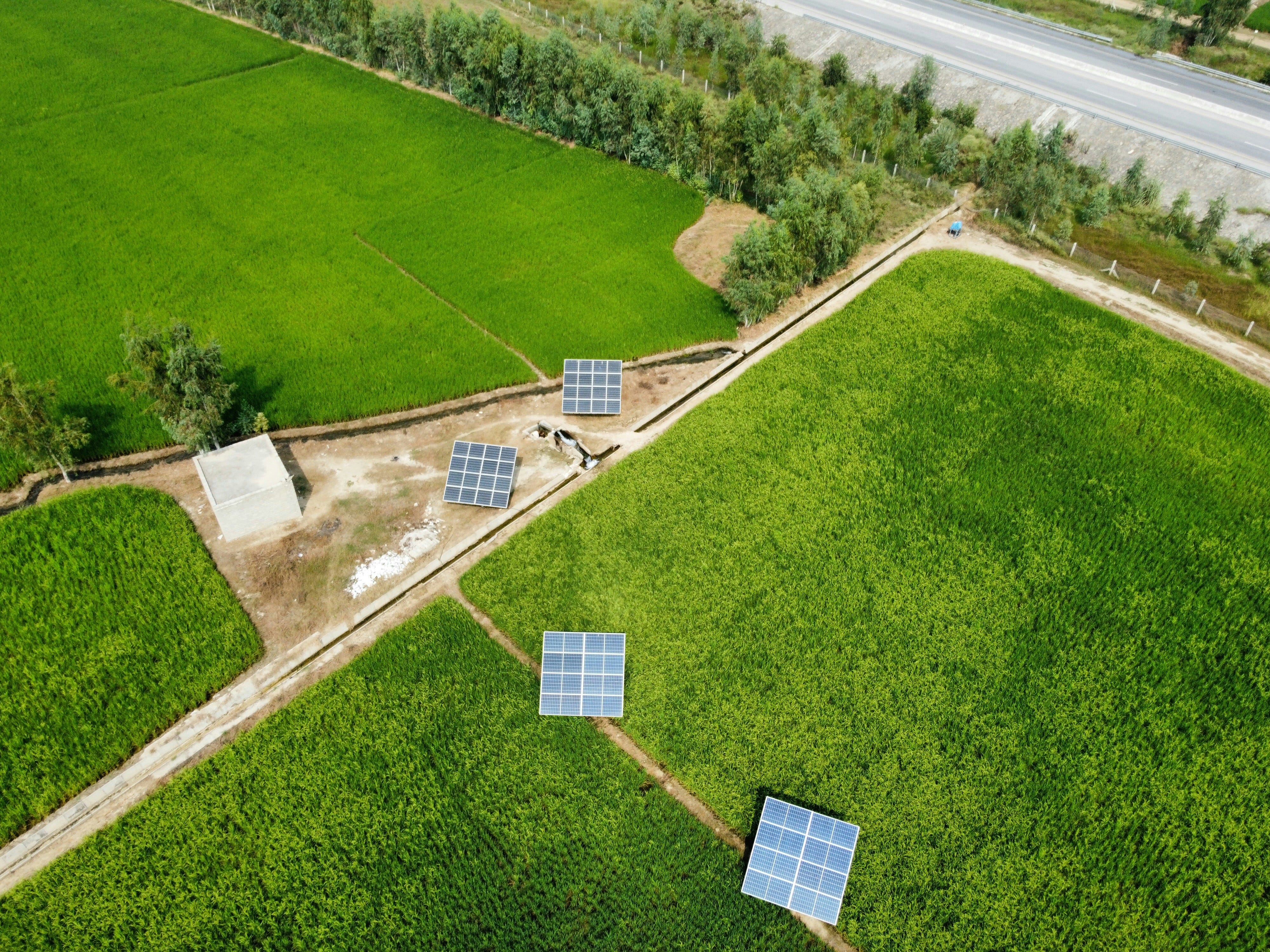
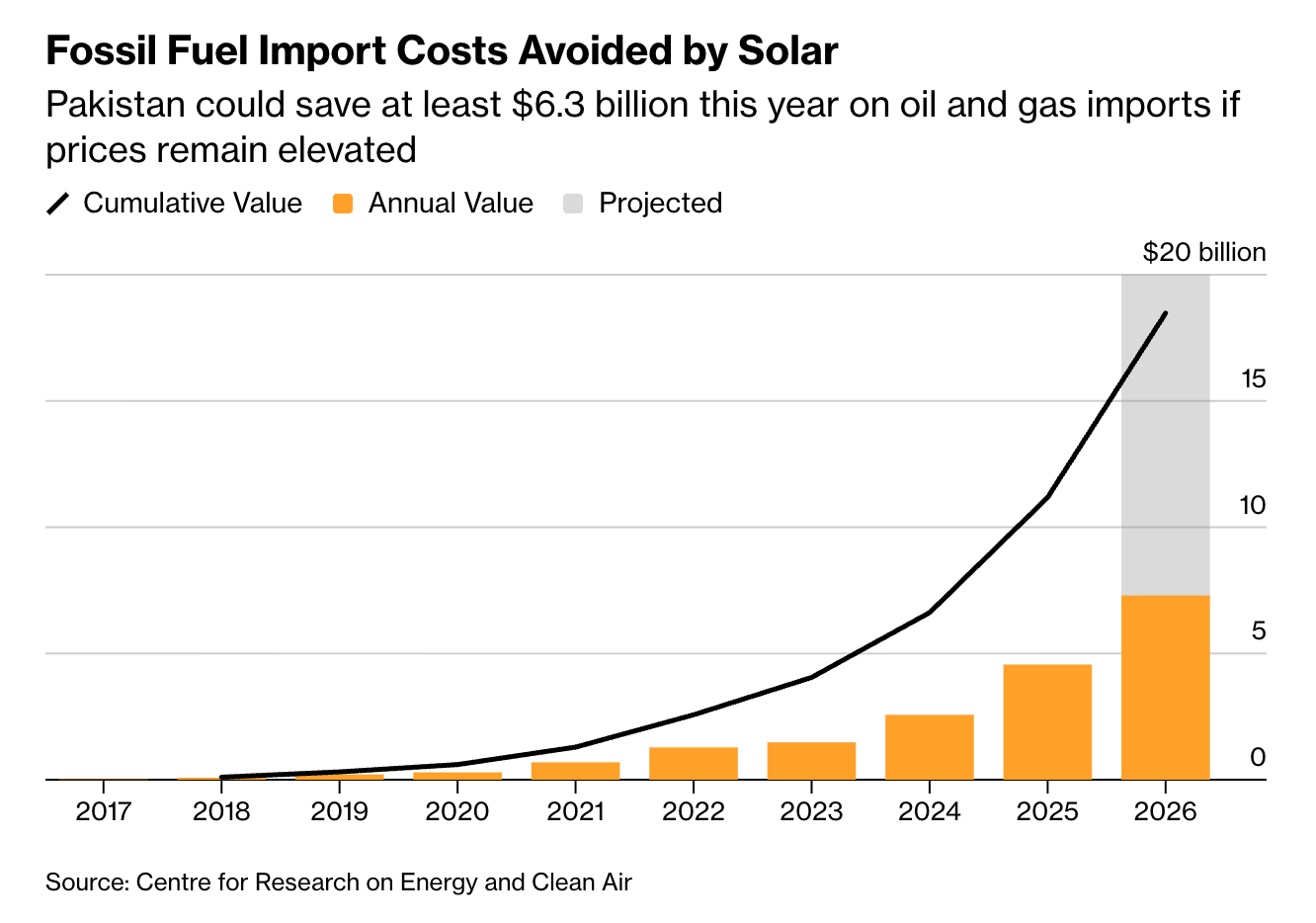
Pakistan has so far vindicated that argument. The solar transformation helped reduce their exposure to the price rises in fossil fuels this year by at least $6.3 billion, equivalent to 1.7% of the country’s GDP.
The underappreciated case for solar has to do with the sovereignty. Renewables localize power, as we wrote in our 2024 essay on the dawn of the distributed age; Pakistanis are increasingly responsible for their energy security. And it’s not just the sovereignty that matters here but its compounding effects. Our position is that solar as technology is undergoing a supercycle, the declining cost of solar panels will drive the opening of new markets which means that every year that Pakistan continues to replace fossil fuels with solar, it is building a durable technology stack to participate in the new economy.
Not delegating judgment
Last weekend, I spotted the AI legend, Andrej Karpathy, had vibe-coded an overview of AI labor market risk. It was rapidly spreading across X. As I strolled down to my studio, a three-minute mosey, I asked my OpenClaw agent, R Mini Arnold, to do this for more than just the US.
After about 15 minutes, it came back with an interactive tool covering 25 countries. For each country, it grabbed employment by job category, as defined by the relevant statistical authority. Then it scored 1.4 billion jobs across several hundred categories in those two dozen-and-change countries. You can see the screenshot of the version I built below. I’ve obfuscated some numbers.
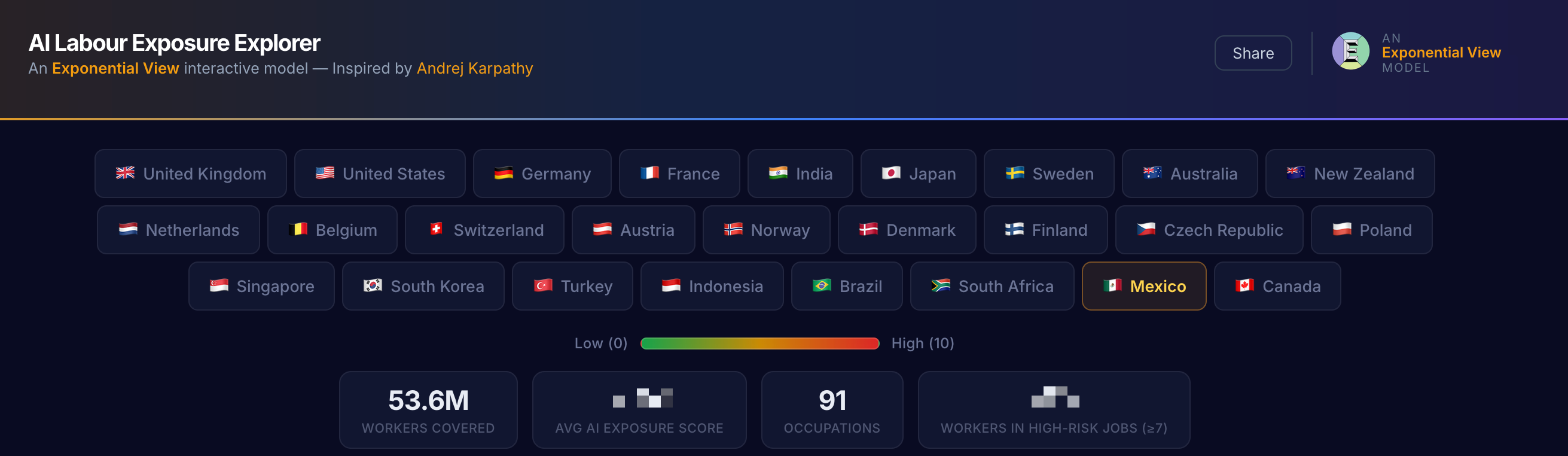
In the old world, this kind of first draft would’ve cost a major consultancy seven figures and taken months of work. My second reaction was, I want to share this with the Exponential View community. But I took three deep breaths and decided it would be an irresponsible thing to do. Andrej deleted his v1 after pushback: he said people were misinterpreting the data. The second version is live here.
I won’t get bogged down in whether Andrej was right or wrong to publish this exploratory tool the way he did. But I will tell you why I didn’t publish my casual vibe-coded map of jobs at risk. In simplest terms, information and analysis matter. They carry consequences for how people understand their role in the world.