
Along Ukraine’s eastern front, a drone stutters mid-flight. On the operator’s screen a few kilometers away, the grainy view of splintered treelines and trenches, fades into static. The control link drops. He removes his headset, he knows what’s happened. Russia has found a way to jam the frequency. Again.
It’s 2024, near Bakmut, a few kilometers from the then-front line. The commander of the Terra drone unit of the 3rd Separate Assault Brigade Mykola Volokhov, has watched the slow degradation of his command links. A system that had worked at eight kilometers out, started to fail at four, then at two. Russian electronic warfare teams were getting better and better with their jamming. Later, speaking on camera, Mykola described the reversal with a soldier’s understatement. “But this problem was overcome… and now it is not with us. No problems!”
The repair did not come through a ministry, a tender or a requisition form. It came through a phone call. In the words of Dimko Zhluktenko, a soldier in Ukraine’s Unmanned Systems Forces:
We called the manufacturer and said, ‘Guys, we had this kind of issue...’ It is very direct, and they are very open to help us. They don’t need a shitload of documents or anything.
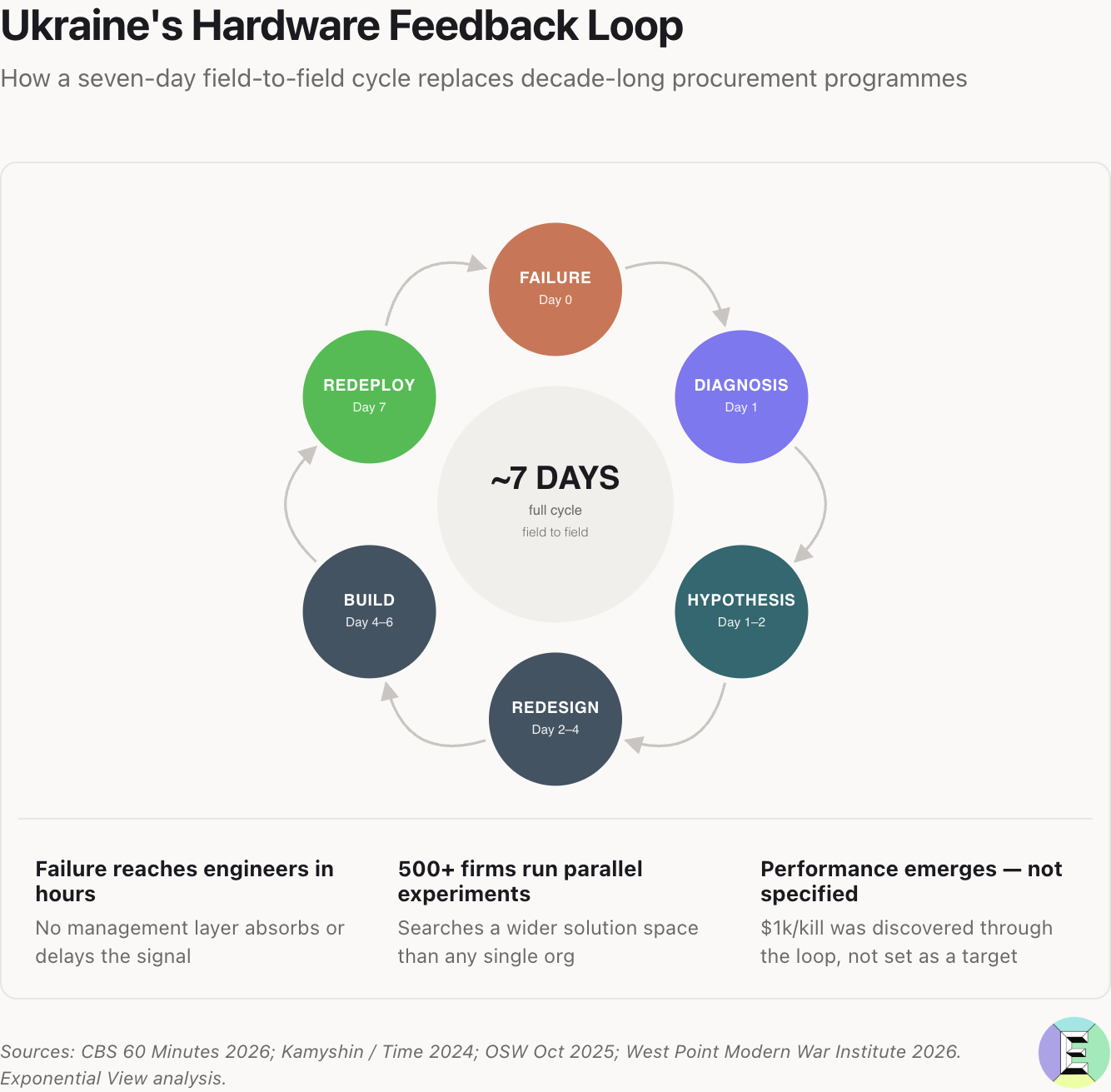
This is the operating model. A device is designed, fielded, disabled by the enemy, diagnosed through a conversation between the operator who lost it and the engineer who built it, then redesigned and redeployed in roughly seven days.
Industrial tempo in the grueling conditions of war. Continuity of signal, of keeping systems operational outweighs a lot else. In one unit along the Dnipro, an operator refused to take shelter during 120mm mortar fire because moving would break the radio link to his drone mid-mission.
This is how military innovation happens on parts of the Ukrainian front.

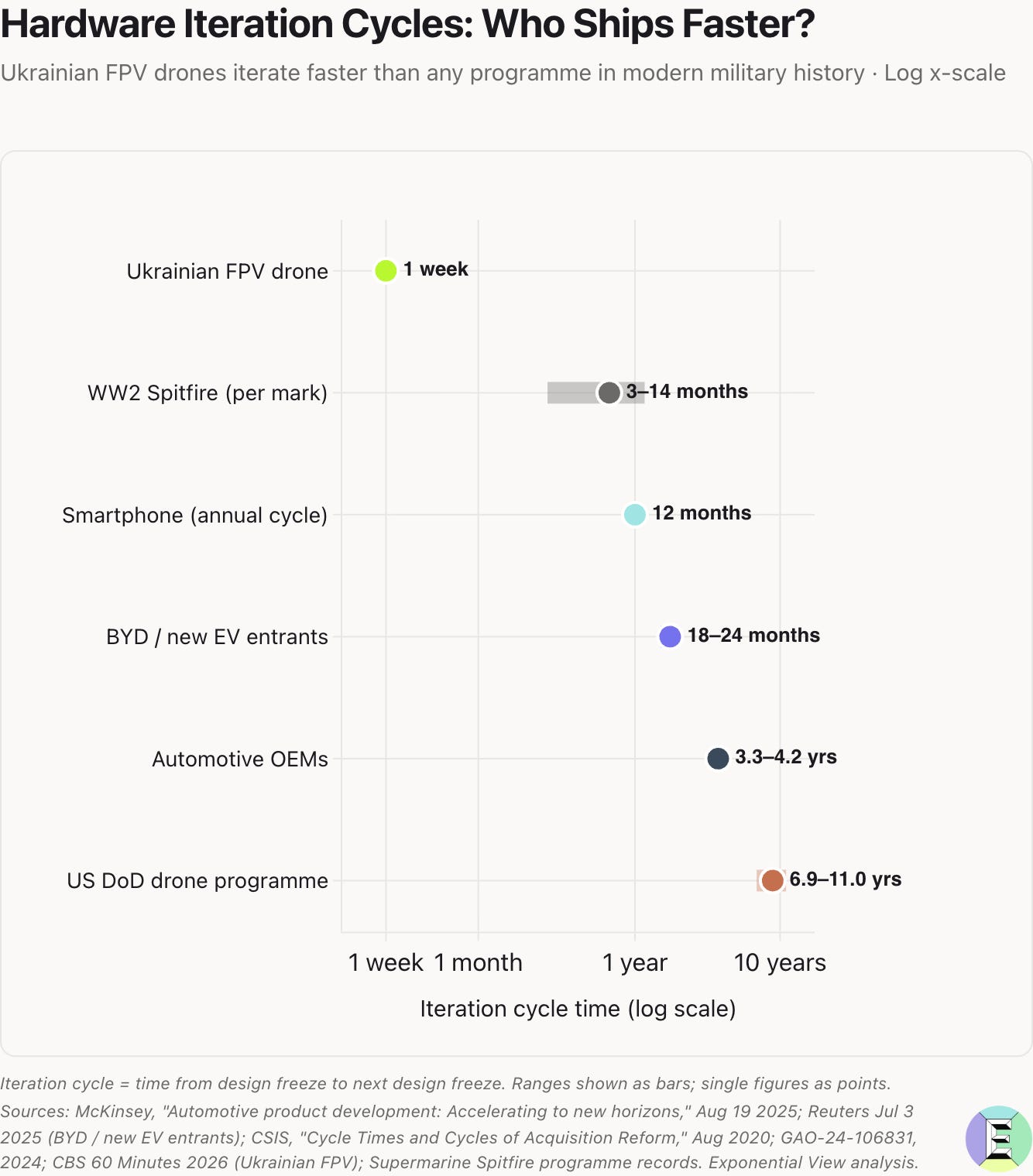
In the US and Europe, weapons systems move from concept to deployment over five, ten, sometimes fifteen years. A major capability iteration of the flagship F-35 Lightning II fighter jet can take close to a decade. That gap – one week versus seven years – is not just down to the exceptional engineering talent in Ukraine. It is the product of how work is organized, how quickly information reaches the people who can act on it and how much authority those people hold.
It is a real-time demonstration of what becomes possible when you remove the layers between the person who sees the problem and the person who can fix it. Under fire, alacrity is the difference between life and death.
While the stakes are as new as they are high, the lesson carries well beyond the muddy, blood-soaked, adrenaline-drenched trenches of Ukraine. It’s a lesson that will determine which nations will succeed, which will falter, which will invite attack, and which will stand firm as this century slowly fills with conflict.
The formula
In early 2024, Oleksii Kamyshin, then Ukraine’s Minister of Strategic Industries, formalized a new metric, “cost per kill”, as unit cost divided by probability of success multiplied by expected effect. However gruesome it may sound to those of us who never experienced war, for the Ukrainian military, it was clean, easy-to-understand, and something they could optimize.
It’s “the formula,” he said. You can’t improve what you don’t measure.
The formula directs production decisions across the industrial defense ecosystem. Weapons are not evaluated on whether they meet a specification written before the war. That is ancient history. The evaluation is the following: in the field, did the weapons work at a price the system can afford? If not, the runts are discarded, no matter the sunk cost. The high performers are scaled. The cost per kill today is $1,000, down from around $60,000 in 2022.
Much of this is familiar to Western firms, defense or otherwise. Performance is a criterion. Someone decides the drone should cost $800 and hit the target 70% of the time. The org spends three years building toward those numbers. By the time the product ships, the specification is an artefact of a long-forgotten planning meeting.
The $1,000 cost-per-kill came from a feedback loop of engineers talking directly to operators, designs changing every week, five hundred manufacturers running parallel experiments which are treated as data. Competitors can copy the number or buy the solution, but without copying the loop, they’ll just have a new specification that a slow system will fail to meet. Performance is what the system arrives at, not what it’s told to produce.
The cycle
Early drones relied on standard radio control. In the Ukraine context, this worked until Russian units learned to jam or spoof their signals. So the Ukrainians initiated dozens of competing experiments across hundreds of small manufacturers, running simultaneously and without coordination.
Some engineers switched to fibre-optic guidance, a physical cable, unjammable by definition, but easily cut while in flight. Others tried an encrypted multiband radio for more flexibility, but still vulnerable to interference. What stuck was a hybrid – fibre with a live radio fallback for the moment the cable breaks.
The entire process happens within days and weeks and the speed shows up in their outcomes. Oleksiy Babenko, founder of drone manufacturer Vyriy Drone shared that the rapid iteration process – task-specific development, direct operator-to-engineer feedback, weekly redesign – increased target accuracy from around 10% to 70%, then 80% within a single upgrade cycle.
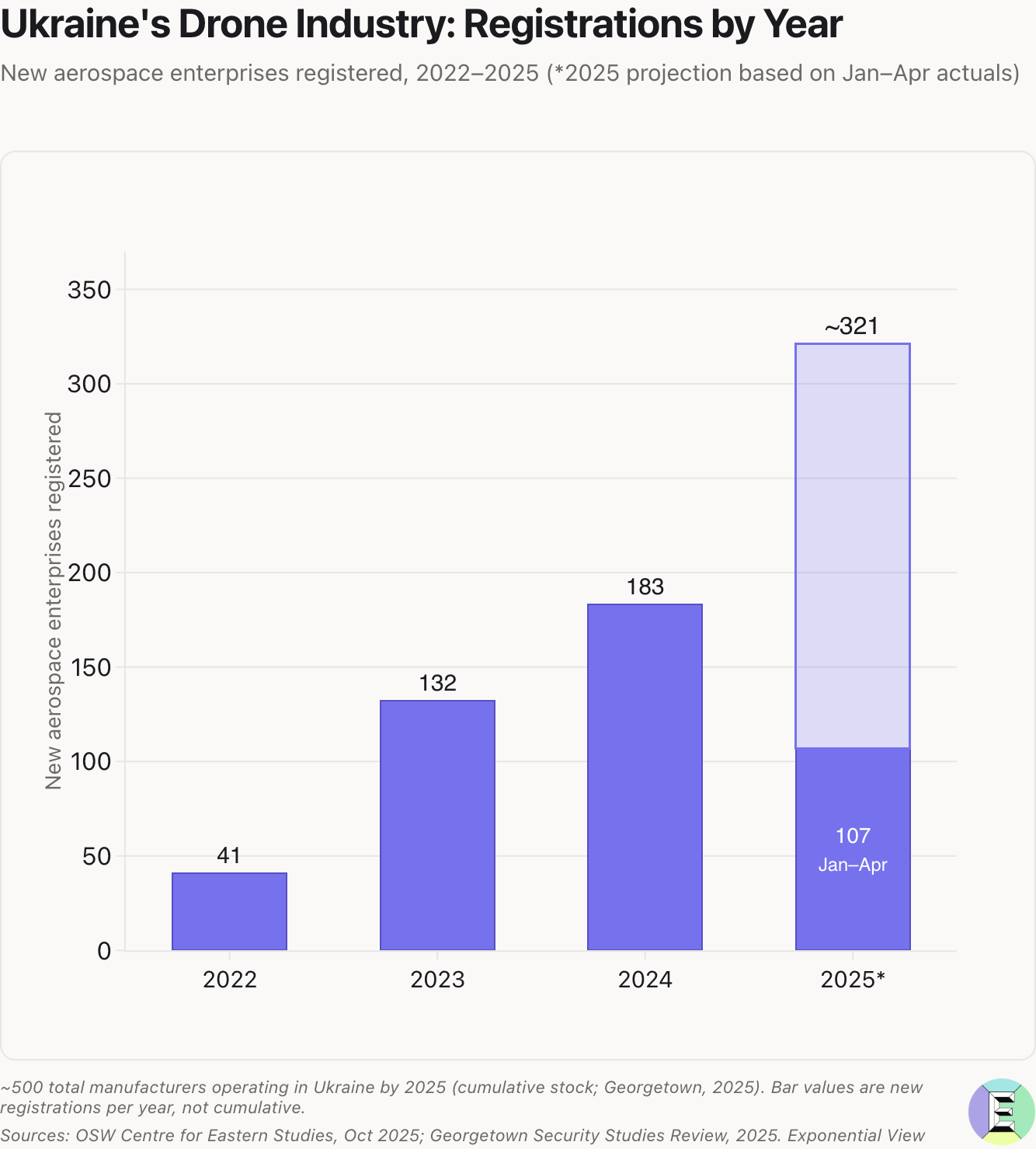
The network
When Putin launched his invasion in 2022, there were perhaps seven domestic drone manufacturers in the whole of Ukraine. Today, Ukraine sports about five hundred manufacturers. Last year, they collectively produced 4 million units. The forecast for this year is seven million. Roughly 140x more drones than the United States produces in a year.
This scale hasn’t compromised speed. Production is distributed and it has followed the same design pattern established in the early phases of the war. There is no single dominant contractor. There is no centralized R&D pipeline. Hundreds of firms operate in parallel, each pursuing its own variations on shared problems. When conditions change, and on the battlefield there is more change than constancy, the network responds. It is simultaneous, emergent, like an immune system.
The individual firms do not have to be faster than their Western counterparts – some are, but that isn’t the point – it’s that the system as a whole is faster. The network searches a wider space for solutions, with far more simultaneous bets than any monolith can. This system is also more resilient. Firms can fail, factories can be bombed. The network persists.
More subtle but less obvious, is the variety and breadth of innovation. Curiosity is a byproduct of the network itself. Solutions win because they work. Those that succeed are stamped, repeated, scaled. Those that don’t disappear.
The Exponential View House View: Hardware iteration speed is an organizational phenomenon, not an engineering one.
The one-week cycle is not a product of exceptional engineering talent. Ukraine’s engineers are skilled, but they are not uniquely so. The cycle is a product of feedback loop architecture: how quickly failure data reaches the people who can act on it, and how many parallel experiments are running simultaneously. Any organization that treats hardware R&D as a capability problem rather than a structural problem will misdiagnose it – and find that importing the metric without importing the structure produces neither the speed nor the cost.
The line
Ukraine has industrialized its drone capability. Underground warehouses far from the frontlines hum with the business of reengineering and manufacturing UAVs. Some of these complexes span hundreds of thousands of square feet; one facility can produce ten thousand units a month. Much of the work remains manual, but follows standardized steps. It’s light manufacturing under conditions of constant redesign. Cat Buchatskiy from Ukrainian defense analytics and innovation center Snake Island Institute told Jordan Schneider recently:
It’s comparable to what you’d see at SpaceX’s Starlink production line. This is not a garage shop industry. Our prime contractors (though we don’t have traditional primes) are producing tens of thousands of units per month and generating tens of millions of dollars in revenue.
Western manufacturing industry has always traded off scale and stability. Whether you’re making cars, semiconductors, or aircraft, a high-volume production line is a capital commitment made in advance of demand. Every lathe or robotic arm fits within a design made years before that can’t change without unravelling the investment.
According to its own estimates, if GM retools a plant rather than building a new one, the saving is $1.5 billion per facility. Honda is investing more than $1 billion to reconfigure three US plants for mixed powertrain production. Toyota’s Kentucky facility – the company’s largest plant globally – recently committed another $800 million to modernize its lines for EV production.
Every industry that has ever scaled manufacturing locks the design before the line is built.
Ukraine has broken these rules. Monthly FPV1 output grew from roughly 20,000 units in early 2024 to 200,000 by the end of the same year – a tenfold increase in twelve months, even as the designs running down those lines changed week by week.
The core mechanism is modularity (read our primer on modularity here). Most Ukrainian drone designs share standardized components, common software frameworks and interchangeable subsystems. A new guidance update or jamming-resistant radio does not require retooling the line. It requires swapping a module. Ten thousand units a month and weekly design changes don’t disrupt the process; they are the same system.2
Many of the people at the heart of this system have no background in the defense industry. They come from software, gaming, marketing, even B2B SaaS. Again, Cat Buchatskiy shared that “[o]ne of the biggest defensetech VCs now supporting the industry used to be the chief marketing officer at a workflow automation company. Many were working at Uber Ukraine or other rideshare companies when the invasion began.”