Companies are backing their AI claims with more numbers. What do these numbers actually tell us about AI’s economic impact?
Today’s Monday Data shares our take in an extract from the first edition of AI Investment Brief, our new publication that provides essential weekly analysis of the AI cycle.
The new publication gives us room to broaden Exponential View’s coverage across technology, economics and society while keeping a close eye on the AI cycle.
We’ll be back with regular Monday Data next week!
Azeem
An extract from AI Investment Brief #1
What corporate AI claims reveal – and leave unanswered
This week we explore the impact of generative AI on the wider corporate economy by analyzing earnings calls from S&P 500 companies and the claims that they make. The type of claims we’ve seen this quarter:
$FDS: “overall ASV growth among clients using our AI solutions was 50% higher than for the rest of the book”
$FIS: “On servicing, we’ve launched 5 Agentic programs with manual tickets down 70% and triage time down nearly 75%.”
$GE: “using AI to automate the process, we cut the number of demand signals in half and reduced processing time by nearly 90% across 190 parts”
$MDT: “CathWorks, our AI and advanced computational science platform for angio-based FFR contributing nearly 300 basis points of organic growth”
$WTW: “where we’re using these tools for automated document reviews for new clients, system configuration time has gone down 60%”
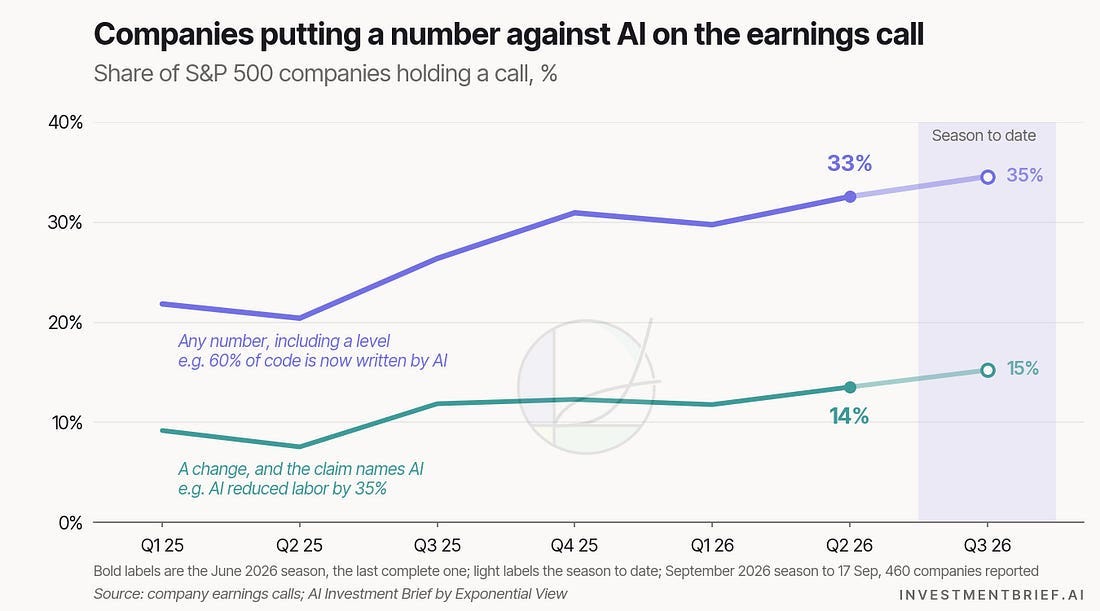
33% of S&P 500 companies that held a call in the June 2026 season made a quantified statement about their use of AI, with 35% of calls in the quarter-to-date including quantified mentions, around 10pp higher than the same time last year.
15% this quarter have made a quantified claim of AI’s impact on the business, up from 9% at the start of last year. Slow growth from a low base.
Together, these show that AI is steadily being adopted (and importantly, measured) in the wider economy, but it still sits at an extremely early stage (or, more bearishly, that most companies are not yet seeing measured AI results they can report to their shareholders).
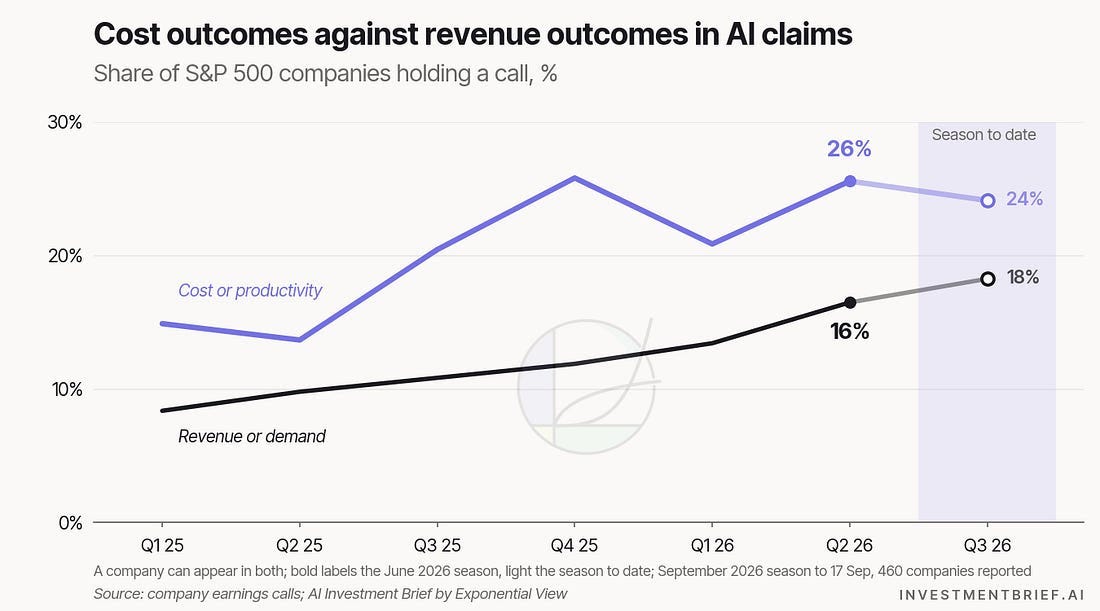
Claims about the type of impact AI is having on businesses are rising: while we expect cost/productivity improvements to be first when implementing a new technology, claims about AI having a positive impact on revenue or demand have risen at a similar rate to 18%.
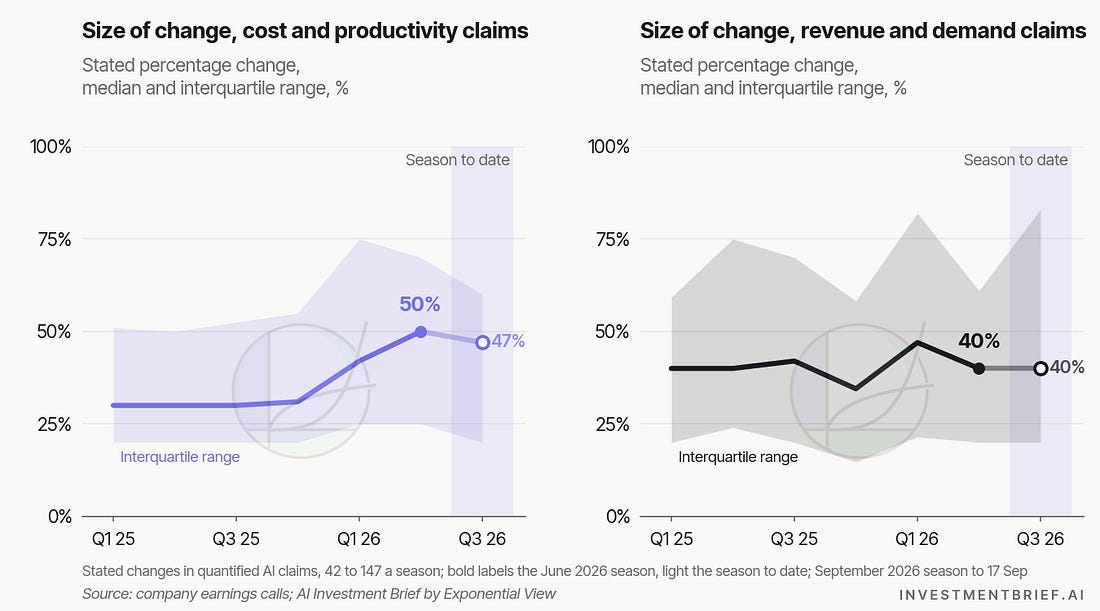
As well as being more prevalent, claims about cost and productivity impacts seem to be of a greater magnitude: the average claim this quarter has been of a 47% boost, vs 40% for revenue growth impacts (and that’s over a wider cohort: 24% vs 18%). These averages sit within each other’s interquartile range (i.e., there’s a lot of spread and uncertainty baked into the average): take with a pinch of salt, and work with the ranges (20-60% for cost/productivity; 20-83% for revenue/demand).
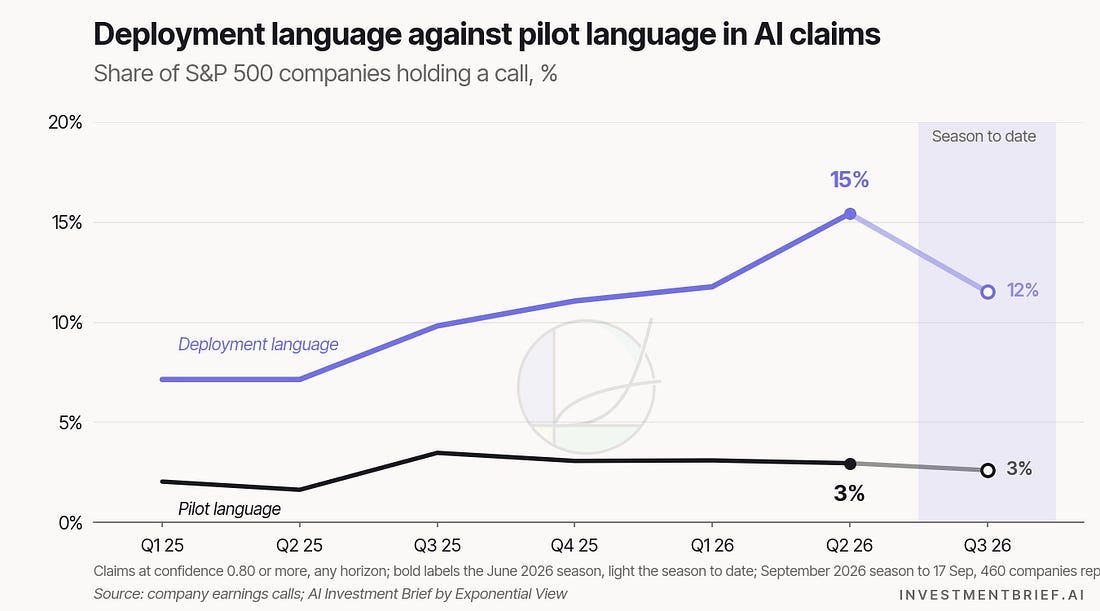
Companies are increasingly using the language of deployment to discuss their AI initiatives (with a dip so far this quarter), rising from 7% at the start of 2025 to 12% this quarter. Pilot language stayed under 4% in every season. It’s clear that even if companies are conducting pilots, they’re not talking about them in calls. This will obfuscate attempts to understand how successful these pilots and investments are, and early signs of promise will only be mentioned in later periods.
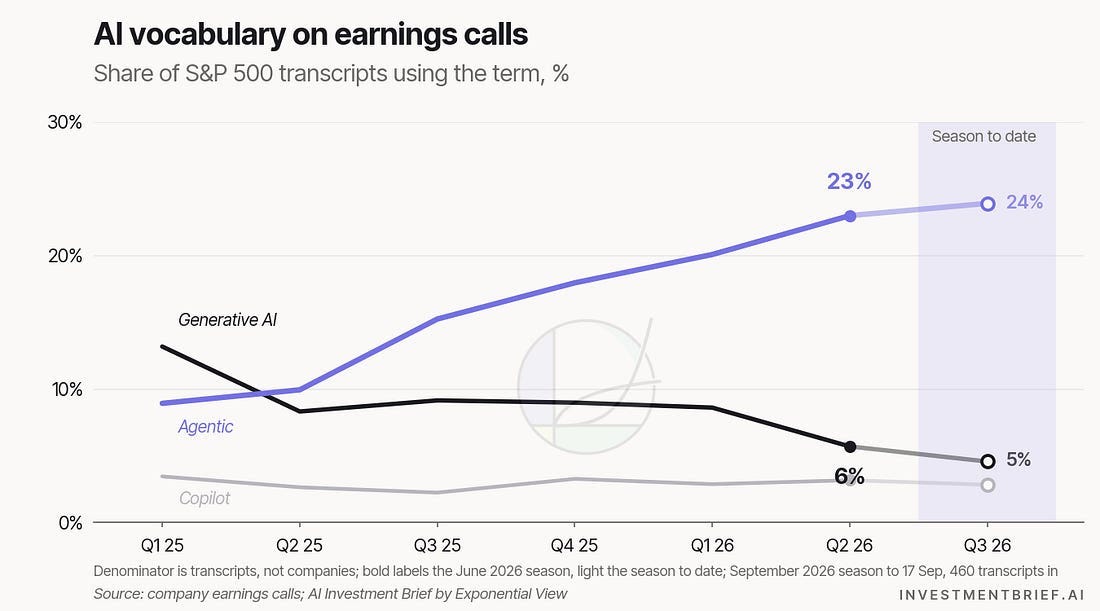
“Agentic” appeared in 24% of calls this quarter so far (up from 9% in Q1 2025).
“Generative AI” fell from 13% to 5% over the same window.
“Copilot” is consistently infrequently mentioned (~3% of calls throughout).
This is an excerpt from the first edition of AI Investment Brief, a new publication by Exponential View.