
“You inspire me to think more exponentially. — Robin D., a paying subscriber
AI AND GEOPOLITICS
Deep Kimpact
Moonshot AI’s new open model, Kimi K3, might be more of a shock to the US than the original DeepSeek model. As a model, it is very good.
I’m wary about benchmarks because benchmarks aren’t the real world. But the emerging consensus appears to be better than Claude Opus 4.8 and, in some cases, on par with Claude’s Fable and OpenAI’s GPT 5.6. The real question, of course, is on which dimensions does K3 beat the frontier labs, and for which workloads are those dimensions important?
Price-wise, it is expensive for an open-weight model. According to Artificial Analysis, it’s about the same price as GPT 5.6 Sol but about 24x more expensive than DeepSeek V4 Pro. Indeed, on a per-token basis, it is only half the price of OpenAI’s GPT 5.6 Sol, far from the usual price advantages of Chinese models.
For the AI economy as a whole, for companies around the world, for governments that aren’t rich, this is probably a net positive. The inference margins that OpenAI and Anthropic enjoy are significant, and they can maintain them because they have the very best models. But it’s pressure, not displacement. Enterprises don’t buy on price alone. They value security, support and possibly the fancy professional services on offer. And the harnesses OpenAI and Anthropic have built remain a differentiator.
As we argued in the State of the AI Economy, token demand is elastic. Falling prices drive demand, and that demand drives infrastructure usage. Hyperscalers and neoclouds will serve these higher-end open models, further fueling demand for compute and everything around it. This pushes more of the revenue pool towards the compute layer and away from the model layer margin. This strengthens rather than weakens the infrastructure payback case—and, of course, the chip and memory suppliers that sit below them. A tempering note: cheaper intelligence still waits for monthly management meetings and a slow-moving approval process.
A MESSAGE FROM OUR SPONSOR, OKTA
Get your AI agent security right

Your AI pilot worked, but now comes the hard part – deploying AI agents across a company that wasn’t designed for autonomous software.
To deploy your agents safely, you need to know what AI can access, what it can act on, and where accountability sits.
Okta’s AI Identity Readiness assessment will score the security of your AI agents and show exactly what you need to fix to go to production with peace of mind.
Run the 5-minute assessment to benchmark your organization.
ENERGY
Solar will be fine, or will it?
Lazard’s latest energy cost report shows that the levelized cost of solar photovoltaic electricity has risen in the US on a year-on-year basis. Back in 2021, this was $38 per MWh; in 2026, it’s $69. The price of gas generation has also risen from $60 to $90.
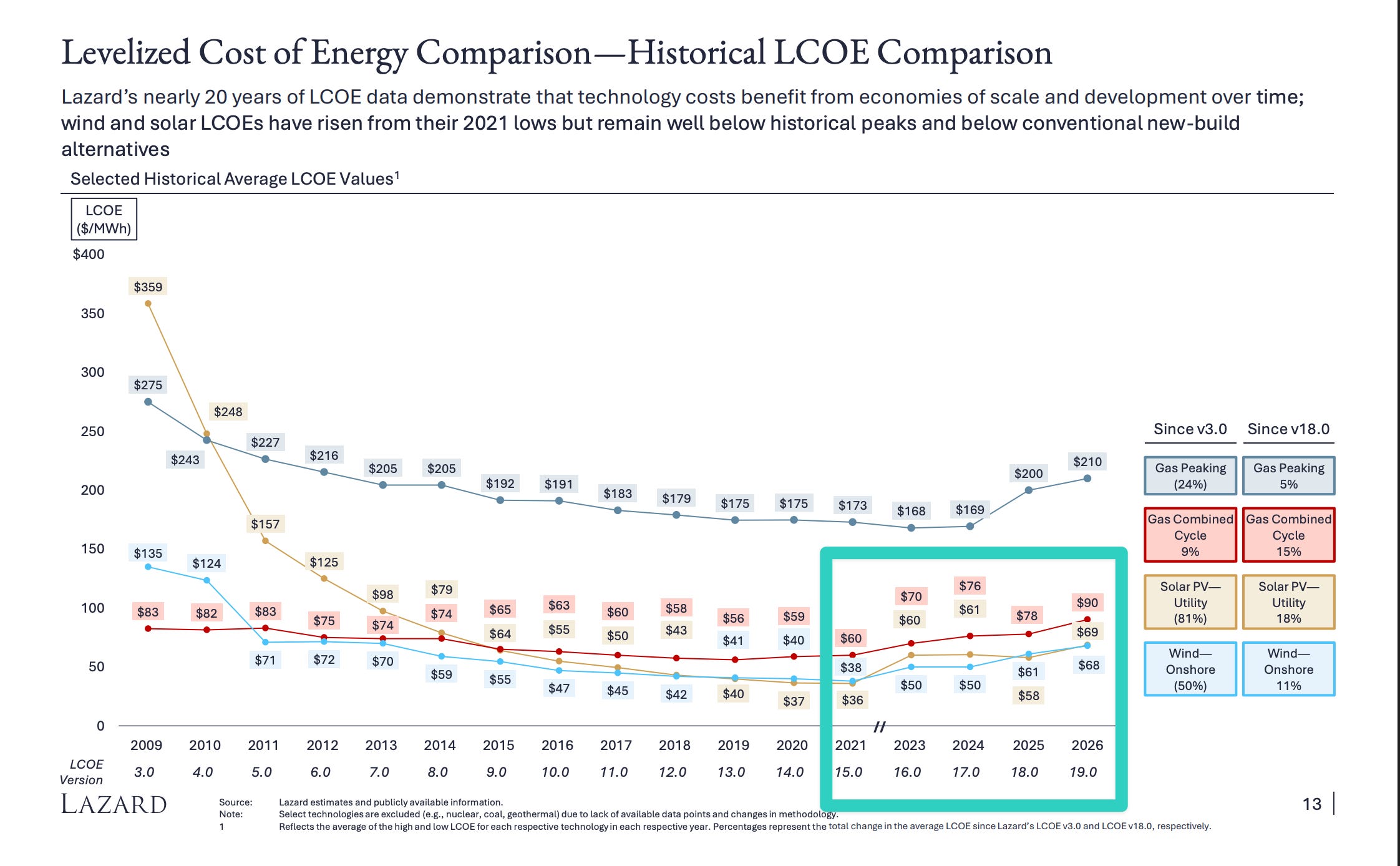
You’d be right to point out that we’ve long argued that because solar panels – one of the key cost elements for solar power generation – are on such strong learning curves, the price will keep trending down.
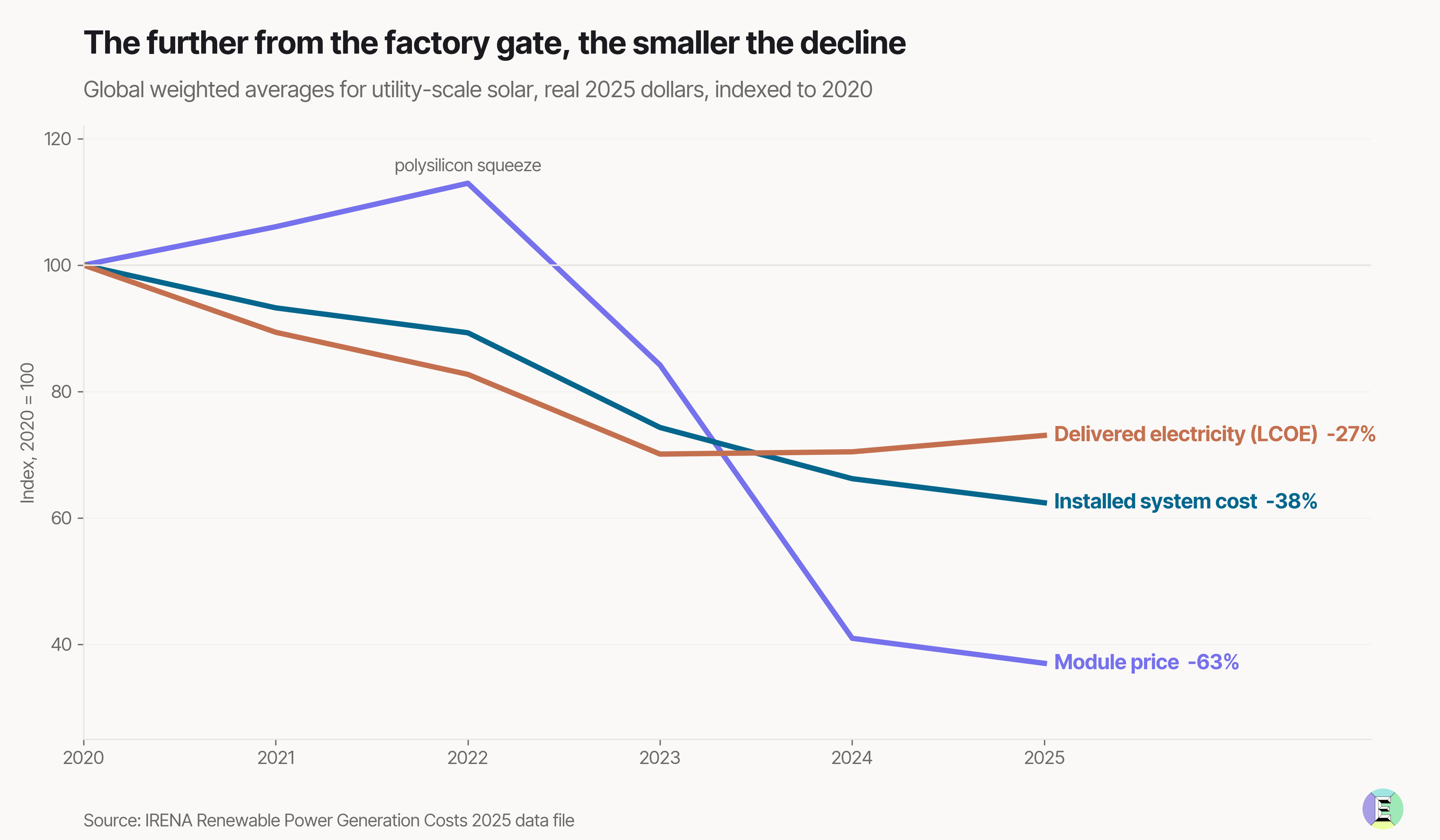
To make sense of this, I looked at the evolution of solar electricity costs in thirteen markets between 2020 and 2025 using data from IRENA, the International Renewable Energy Agency. The headline story is that, yes, PV modules remain on an aggressive learning curve, with unit costs dropping as production increases. Overall systems costs continue to trend downward, but the levelized cost for delivering electricity has risen slightly since 2023.
Member-only
This post includes bonus content for Exponential View members, in which we explain in more detail why this is happening and what to do about it. Upgrade to unlock.
See also:
In June, solar supplied a record 25% of the EU’s electricity, more than nuclear, gas, wind and hydro.
Households in three Australian states are getting three hours of free power every day during peak solar hours.
AI AND SOCIETY
An Anne-style bargain for AI
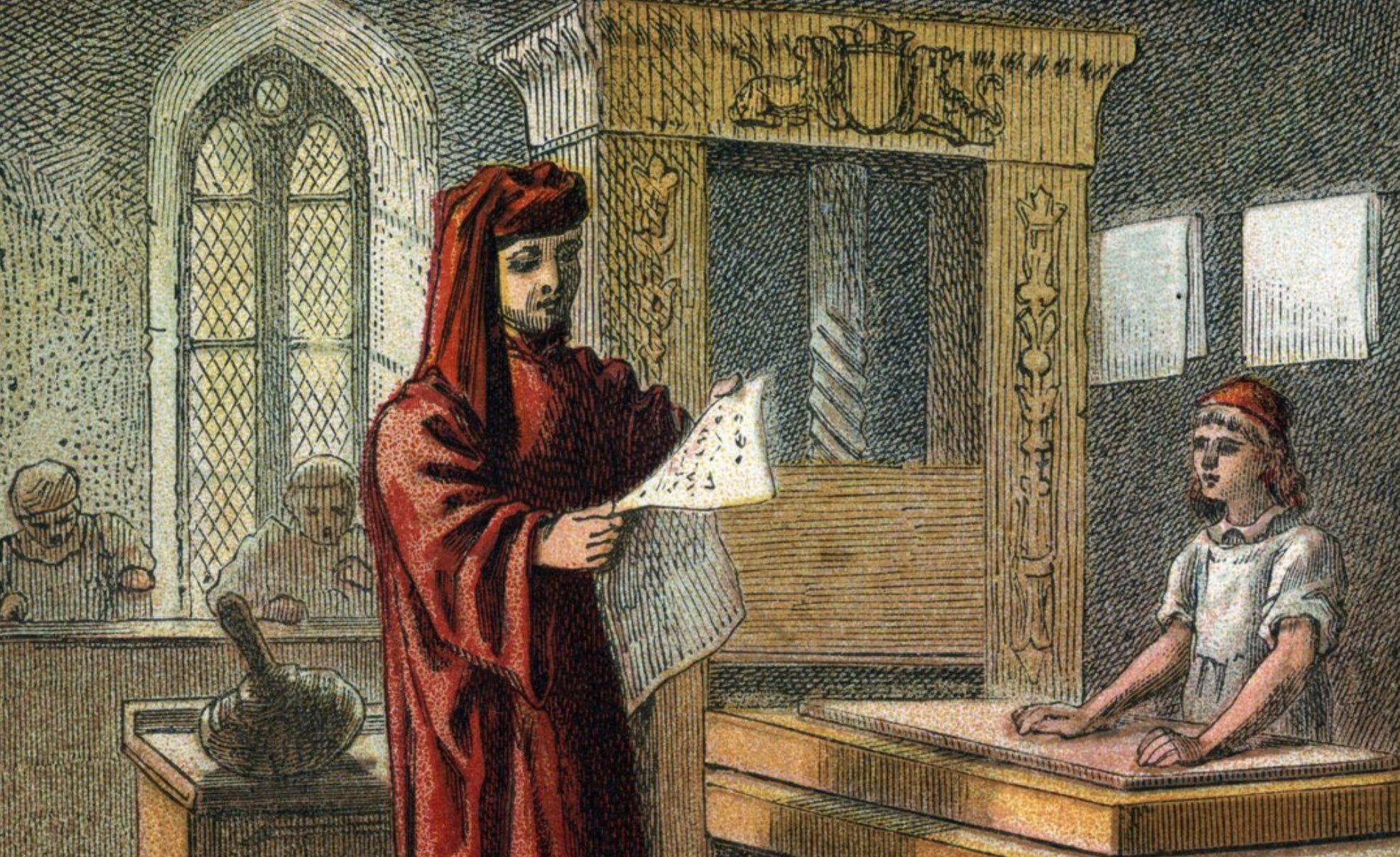
Britain’s first experiments with copyright began in the decades after William Caxton introduced printing in the 1470s. The Crown licensed a single company to police what went to print, and in return, its booksellers had an exclusive right to copy the texts with no end date. This license manufactured scarcity for over a century.
In 1695, Parliament refused to renew the Licensing Act, which enabled the booksellers’ monopoly. That 15-year interregnum brought an explosion of ideas: London gained 70 political periodicals (from one) and print culture spread to the provinces and American colonies. Then, in 1710, Parliament enacted the Statute of Anne: the world’s first copyright law. It gave exclusive rights for a fixed term, just 14 years, renewable once, and then the work went into the public domain. The law’s title was “An Act for the Encouragement of Learning.” Enough scarcity to incentivize creation and freedom after that so that knowledge would compound.
Twenty-first-century economics agrees. Joel Mokyr took the 2025 Nobel Prize for showing how useful knowledge becomes self-generating. Scientific understanding enables new technologies. The problems encountered in applying those technologies stimulate further science. And a society open to new ideas allows each advance to become the foundation for the next. Knowledge does not simply compound; it helps produce more knowledge
In a world of AI, this compounding will be doubly true. And will set up greater tension between content industries, who, like Britain’s booksellers in the 17th century, will want to protect their old business models, and the potential to drive open-source AI models and a raft of complementary startups. Brian Williamson argues that the EU’s Anne-style settlement- its text-and-data mining exception is key to the EU staying at the AI frontier.1 It allows AI to learn from lawfully accessible material:
Machines as well as humans should be free to learn; what matters in terms of protecting creators is whether outputs, not inputs, duplicate existing work.
For Europe, woefully behind in semiconductors, compute infrastructure and foundation models, yielding to copyright lobbies would further weaken its relative position in AI.
MISC
Short morsels to appear smart at dinner parties
AI impact on jobs: Junior roles are being “seniorized,” and employers are more open to humanities graduates.
Russian soldiers’ average survival time after reaching the front is 20-30 minutes.
💸 Prediction markets are starting to bet on AI compute costs.
Hamish Low estimates that China will have a Mythos-like model in February 2027. His full analysis is worth reading.
Claude’s personality changes depending on the model and the language you use with it.
💪🏼 There’s now a promising candidate for the first vaccine to prevent pancreatic cancer.
Apple is testing PrismML’s tech to run big AI models directly on iPhones.
Good short essay by Dwarkesh Patel: “We tend to conflate power-seeking AI and superintelligent AI.”
😷 How Palantir embedded itself in the UK state, an investigation: “Despite having no real history of working with health data, Palantir began positioning itself as the go-to expert and Global Counsel started hiring Westminster insiders who had contacts in healthcare.”
Thanks for reading!

Caveat: It is an independent report, but it’s paid for by Google. However, I think the argument is salient enough to present to you.
It's been true for a while that in the solar industry, most of the costs are now not in the panel but in labor, land, and balance of systems. That's why perovskite tandems are so interesting, in that they're much more efficient, 30-50% more efficient, and can therefore lower the overall costs.
By leveraging this efficiency, my company is one of the leaders in this space and now has a solar panel that's over 30% efficient, compared to the average of 22% or 23% in the market. This is lowering the cost overall by up to 25% through this efficiency advantage. We are at the demonstration / pilot scale and plan high-volume production in 2028.
regarding Kimi K3 all of the internet influencers are blown away by its front-end generation comparable to Fable. this is understandable as most of these influencers are programmers and website designers. moreover, training such a model is straight-forward given that the reward signals are objective -- it runs and gives the proper answer or it doesn't. however, not much focuses on any other sort of work. so i wonder how close it is to the real frontier.