
“With so much hype around the tech, your no-nonsense unbiased assesment is essential.” — RB, a paying member
Reading is dead (again)
Roberto Serrano, a professor at Brown, suspected his economics class was relying on ChatGPT to do their exams. He made the final paper a closed-book exam, and scores for 56 of his 59 students collapsed (by as much as 100%). Kudos to the two students who seem to work unaided.
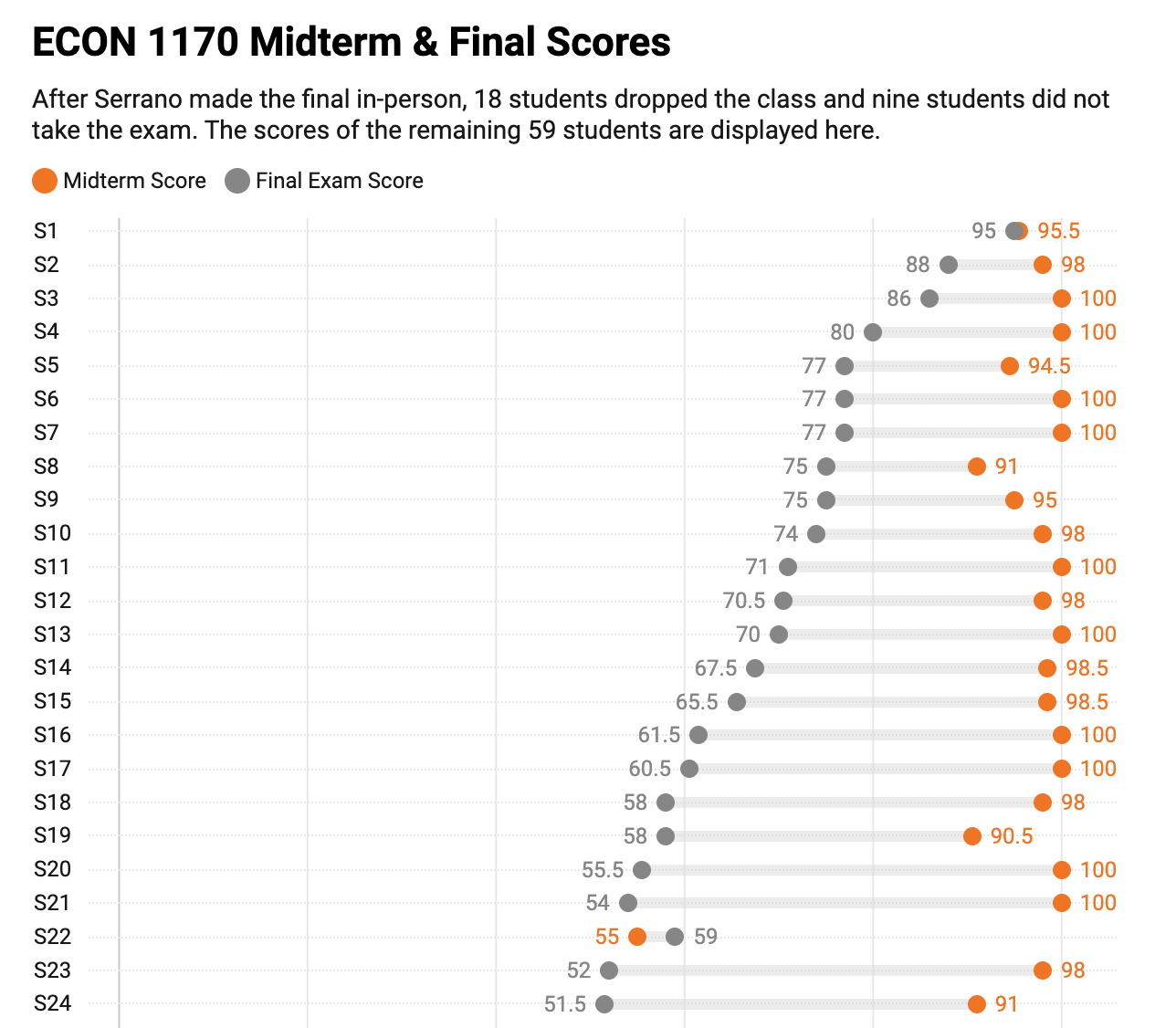
This is a problem of incentives. The students appear to value the high score rather than mastering the subject. Perhaps because the value of a degree is increasingly less about intellectual excellence and more about job-market signalling.
The percentage of Americans who read for pleasure on any given day fell to 16% by 2023, down from 28% in 2004. Literacy, not a natural human state, is a learned skill that needs practice. Americans aren’t practising – postliteracy loves short-form video, after all. These data are from before the rise of generative AI.
Reading in America is a different problem. The data, even pre-AI, is terrible and doesn’t support the notion that post-literacy arrived after ChatGPT. Rather, the trend has been ongoing for at least two decades.
When access to intelligence is uncapped, AI could divide people based on our willingness to think and engage with what is difficult. David Brooks makes the case :
What really matters, therefore, is not brainpower but the willingness to run the mental marathons that produce high-quality results. […] The crucial task before us is to cultivate people’s desire to seek out cognitive complexity. How do we train people to see their life as a hero’s journey in which they take on difficult missions that they may fail at and that will certainly involve pain and suffering?
Reading long-form, constructed arguments that have been closely fought through by an author forces the reader to engage with the material far more deeply than a stream of summaries does. (These may give the illusion of thinking, but that isn’t the case.) I’ve been working on my second book over the past few months, and yes, R Mini Arnold, my agent, has been an extraordinarily helpful research associate. The latest AI models, Fable and GPT 5.6, can be prompted to produce outstanding (almost) research, but you really need to know what to ask and how to ask for it. In my case, that’s meant building up my mental map the old-fashioned way. Which means I need to sit quietly, read original material, consider it critically and handwrite my notes.
Elsewhere:
LinkedIn is awash with AI-generated posts; Substack is less so. I have built a Chrome extension that hides AI-generated content. It makes X more manageable to browse.
The University of Chicago Law School is piloting device-free first-year core classes and requires students to learn to use AI effectively.
“Fable is better than me at my job, but Fable alone would be a mediocre investor,” says one VC.
This isn’t the demand softening you are looking for
No, GPU demand is not softening. Silicon Data’s one-year H100 contract index bottomed near $1.70/hour last October and has since rebounded ~38% to $2.35. Spot prices are up 10% this year.
The SpaceX S1 offers some clues about how future demand might shape up as it discloses the infra deals the firm has signed: a three-year tenor with unusually permissive 90-day cancellation terms.