
Hi, it’s Azeem. Welcome to the free Sunday edition of Exponential View, thank you for being here! Every week, I help you ask the right questions and think more clearly about technology and the near future. For more, see Speaking | Book | Membership | Follow me on Notes
Ideas of the week
An abundance of computation
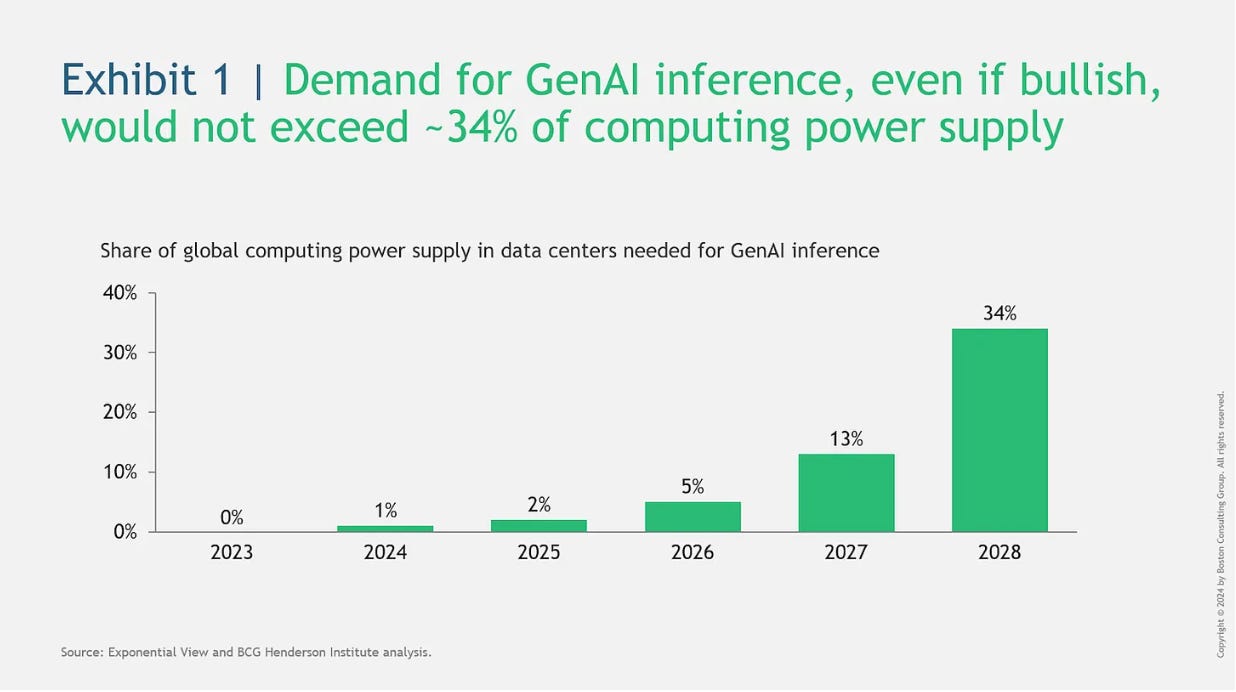
What will you do when you have a thousand times more computing power at your disposal? We partnered with the BCG Henderson Institute to find out. Part 1 of our research shows why the fears that generative AI’s computational demands will disrupt the equilibrium of affordable computing power are not realistic. We found that even bullish demands will not exceed 34% of the power supply. In our models, most of the demand is driven by agentic workflows (that is, AI agents performing tasks with little supervision), which are at the upper end of what is feasible with today’s technology. Even with our very aggressive assumptions, there will be sufficient supply. Organisations should gear up for an abundance of compute, not a lack.
The Nobel
This is a cultural moment more than anything else. Much like how the grand exhibitions of the 19th century captured the optimism and belief in the progress of the Industrial Revolution, the Nobel Committee has captured the belief that AI matters — as it does — by making it central to two Prize categories. Nobel Prizes aren’t dished out on vibes alone: they have to have been important and to have had applications. The Committee has clearly decided AI meets both prerequisites. The recognition of AI in the Nobel Prize in Chemistry, in particular, signifies a milestone – honouring the developers whose computational tools can predict the complexities of chemistry. Chemistry has been heading in this direction for a while, but it took over 20 years of research and an AI with the accuracy of AlphaFold 2 to unlock protein folding. This is why humanity needs AI – we are nearing a critical juncture in knowledge production… I previously wrote:
In the foreseeable – hundreds of years – horizon, we might contend that we are flattening the curve of our knowledge creation – a first for our species. Not only is that an existential turning point, but it’s also a dangerous one. There will still be things to understand, challenges to address, and risks to mitigate, for which knowledge will be required. Where will that come from?
My answer is? AI systems…. just like AlphaFold.
The nature of intelligence
Intelligence is the ability to navigate complexity, rather than just accumulating knowledge. New research has hypothesised that creating AI that exhibits intelligent behaviours may require only exposure to the right level of complexity – challenging conventional approaches that rely on human-curated “intelligent” datasets……
The rest of this commentary is available to paying members.
Backdoors and long picks
The digital realm has long operated on a precarious bargain: tech giants maintain their dominance, while governments retain a backstage pass. This uneasy détente hinges on the notion of “secure” backdoors – a contradiction in terms that’s finally unravelling. Consider the recent Salt Typhoon breach……
The rest of this commentary is available to paying members.
Facebook’s paradoxical polarisation
Can leaving Facebook reduce political polarisation? A new study from The Royal Society suggests not. People who deactivated Facebook felt better about themselves but became more politically ignorant while maintaining their previous political biases……
The rest of this commentary is available to paying members.
Data
Voter turnout around the world has risen for the first time in two decades.
Sixty percent of US consumers have used AI chatbots to help research a purchase in the last month.
Thirty-five minutes. The time it takes a teen to get addicted to TikTok, according to the Kentucky Attorney General.
The rest of this section is open to paying members.
Short morsels to appear smart at dinner parties
👏🏼 The discovery of microRNA, honoured by the Nobel Prize in Physiology or Medicine this year, was fully unexpected. File it under: how curiosity wins!
💨 Carbon capture sequestration may be in jeopardy as the first major US project detects leaks.
🤠 It took farming 5,000 years to reach Denmark from the Fertile Crescent region and 1,000 years to go from Calais to Dover.
Saturday reflections
Which firms in the broader economy will first see gains from using AI? In yesterday’s post, I looked at who will do well apart from the toolmakers, toolmakers’ toolmakers and the ambulance chasers. TL;DR: digital native with strong developer teams. Here’s more on the developer advantage:
💡Which firms will benefit first from AI?

Today I want to look at which firms in the broader economy will first see gains from using AI. I am excluding the following…