
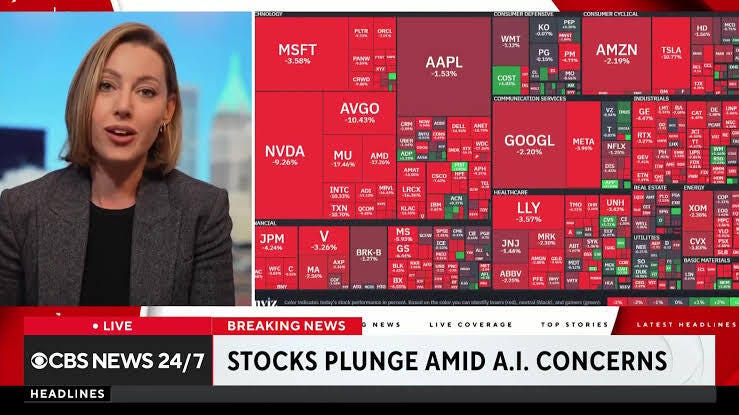
The market ran for cover after the Democrats won the midterms. More than $2.5 trillion was wiped off the Nasdaq as investors fled the picks-and-shovels part of the AI trade. The Democrats made it clear that artificial intelligence would now face the scrutiny we would expect most technologies to face. Some said it more forcefully.

Those concerns are around AI safety, its impact on labor markets, the concentration of power and, of course, the pushback on data centers.
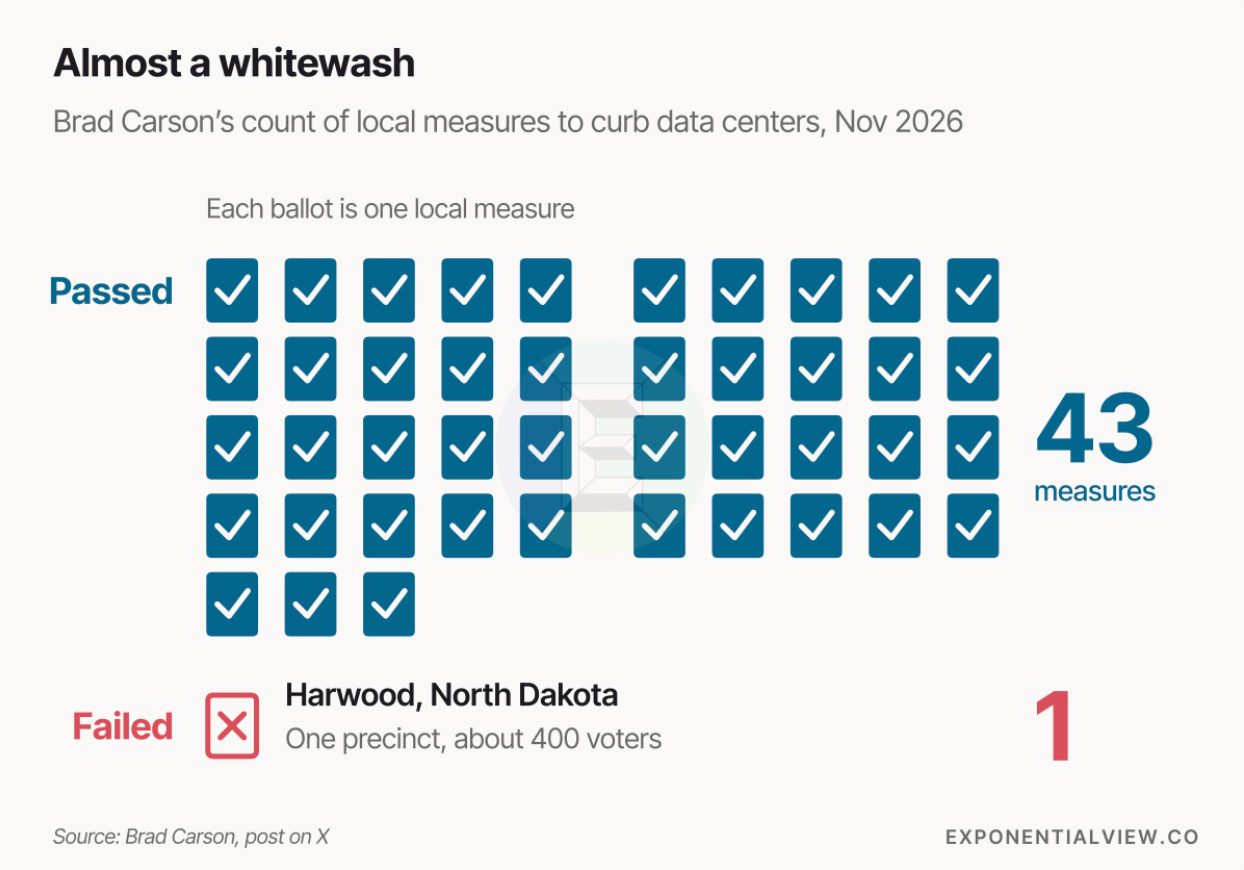
The data center revolt could be the sanest thing to happen to the AI build-out this year. Voters in the US passed 43 of 44 local measures to slow data centers down. This isn’t the death knell of AI, but the price to make it better.
Hyperscalers will pay almost anything for speed, and the places willing to move faster will be in the driving seat. And they should turn that leverage into lasting benefits for their communities.
Data centers were not why the vote went the way it did. The war, the cost of living, and gas prices did more, according to JD Vance. But data centers were on the ballot, and they lost almost everywhere.
Before the midterms, I said on Paul Krugman’s podcast and on Ezra Klein’s show that this revolt against these suburban monoliths was genuine democratic engagement: on many issues, including about how AI is arriving in our lives.
Data centers had become less popular than ICE. Getting the wrong end of the voters’ ire is not a reason to stop building everywhere. It is a reason to strike a deal.
Time is power
High energy prices don’t really matter. Taxes and levies don’t really matter. Time to energize does.
Data centers make tons of money. But to get the cash spigot opening, the data center needs to be a data center.
The most important thing for developers—especially hyperscalers—is turning them on. So a pause on development hurts the best tenants, the hyperscalers, hard. Every B300 AI chip plugged in can make about $8 an hour, according to Silicon Data. It can pay for itself in less than a year. Every B300 sitting in a queue is simply lying idle, not yet adding to the depreciation bill but not paying its way either.
A 1 gigawatt data center of the type coming online now might have around 400,000 B300 chips. The total cost would hit about $40bn. But the annual operating expenditure is under 2.5% of the upfront CapEx bill for a 1GW site, roughly $800m a year. About two-thirds of that is the electricity. The shell might take just 18-24 months to build, while the average US wait time for a power connection is four years. Until the electrons flow, no money can flow. And that is an extraordinary point of leverage.
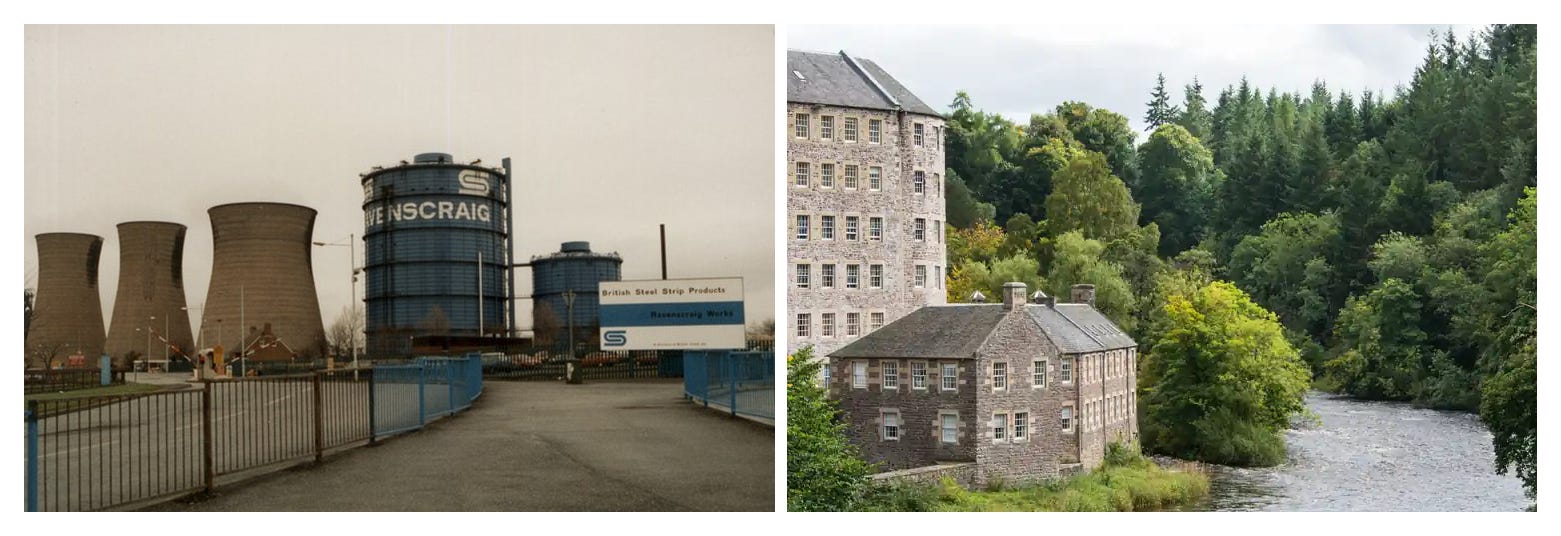
In Lanarkshire, on the outskirts of Glasgow, where Scotland’s 20th-century industrial heartland transitions to the rolling southern uplands, small towns built around UNESCO-heritage 18th-century cotton mills offer the Democrats a template to turn this into a win.
In this case, DataVita, the data center developer, has agreed to pay up to $100,000 per megawatt per year to a local fund for community initiatives like skills and training, education and food banks. When the data center reaches its 500MW capacity, this will mean a $50m-a-year fee. North Lanarkshire, the local council, has annual income of £1.17bn (or $1.58bn), so this is a 3% boost. Over the fifteen-year lifetime, it will run to up to £543m.
By comparison, Oracle sought residents’ approval for a data center in New Mexico, with nearly $1bn in new contracts to local businesses, $155m to offset utility costs, a $50m commitment to water facilities, and a $10,000 grant to a local sports team. But most of this Oracle needed to spend on building, rip that out and you end up at $205m in total. Compared to the Scottish deal, this was a miser’s bargain. Across the campus, it was $84,000 per megawatt, not per year, but as a one-off fee, nearly 18 times stingier than the Lanarkshire compact. If Oracle had met that benchmark, its 15-year bill to the community would have run to $3.5bn.

If the North Lanarkshire benchmark held, every GW of connection could yield $100m to a local community. Infrastructure companies can make $10 to $40 billion per gigawatt of energized AI compute. SpaceX’s surge deals with Anthropic and Google earn nearly $50bn per GW per year. There is plenty to go around. $100m per GW is 0.2% of what a gigawatt can rent for at today’s surge prices. At three or four times that, the levy is still under 1%.
Lanarkshire is a principle. US counties sitting on a four-year grid queue have more leverage. They should ask for more.
This isn’t to say locally negotiated levies are the only thing to aim for. Reducing energy and water bills clearly matters too.
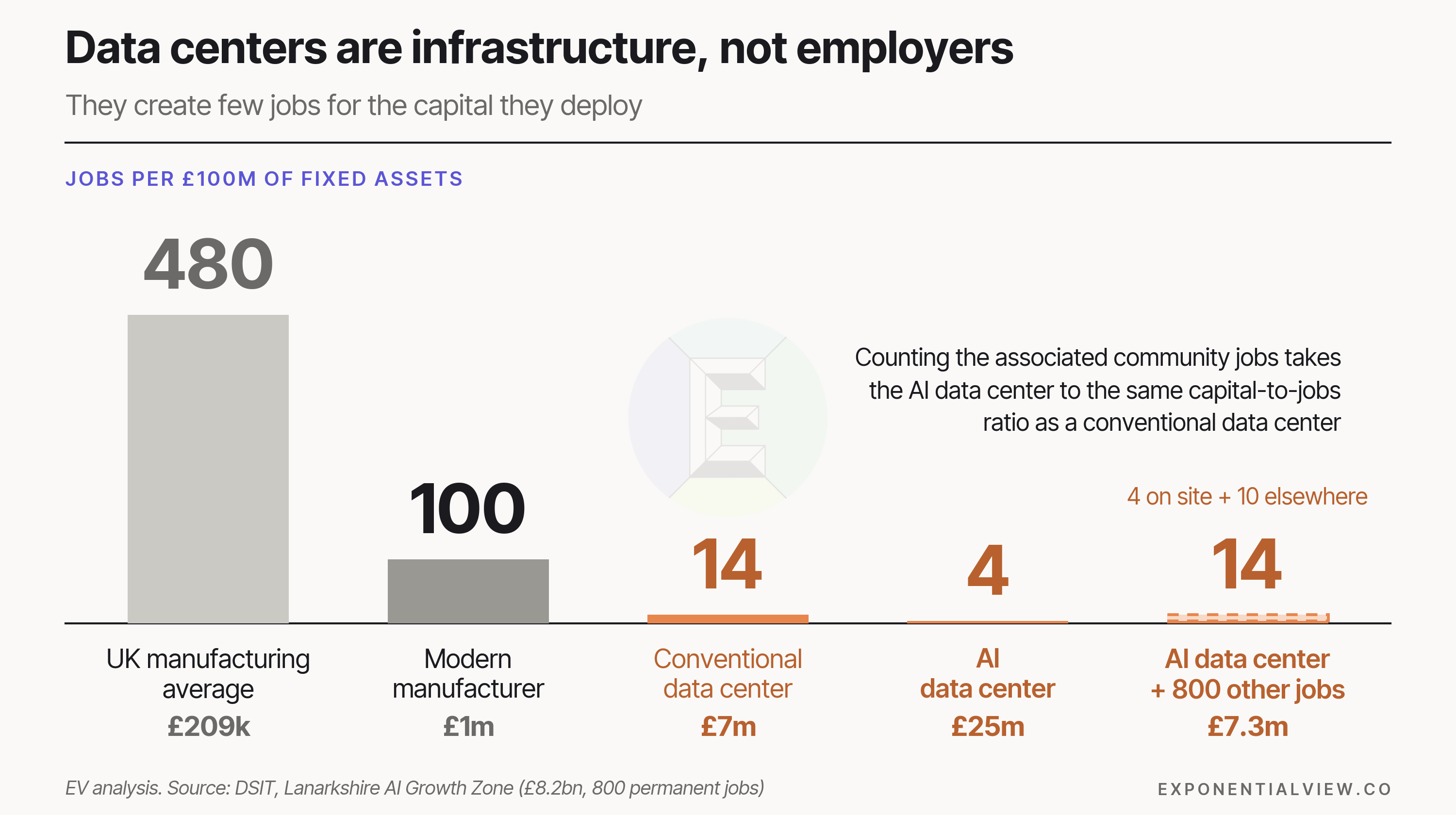
So too does giving something to the local community when construction workers leave. The truth about data centers is that they don’t really employ anyone for every billion dollars sunk into the ground.
While Meta’s Louisiana data center investment grew five-fold to $50 billion, permanent staff numbers only doubled, to 1000. That’s around 20 people per billion spent. Anthropic’s $50bn of builds in New York and Texas will bring 800 permanent jobs. Sixteen people per billion dollars.
Transient construction workers don’t really create healthy, thriving communities—just watch Landman to see that.

But locally negotiated levies can create an annuity stream that communities can use to support local businesses, regenerate, and develop their own internal heat. Go back to Lanarkshire, where running the data center will likely employ 220 people. As part of the politically mediated agreement, the AI Growth Zone plans to create around 600 jobs for “AI researchers and coders”. As the chart below shows, this nudges that jobs-to-capital ratio up a little, but it's still far from modern manufacturing.
Smart data center policy can turn this revolt into a durable win for Democrats and their communities. Get the full playbook as a paid subscriber.

